
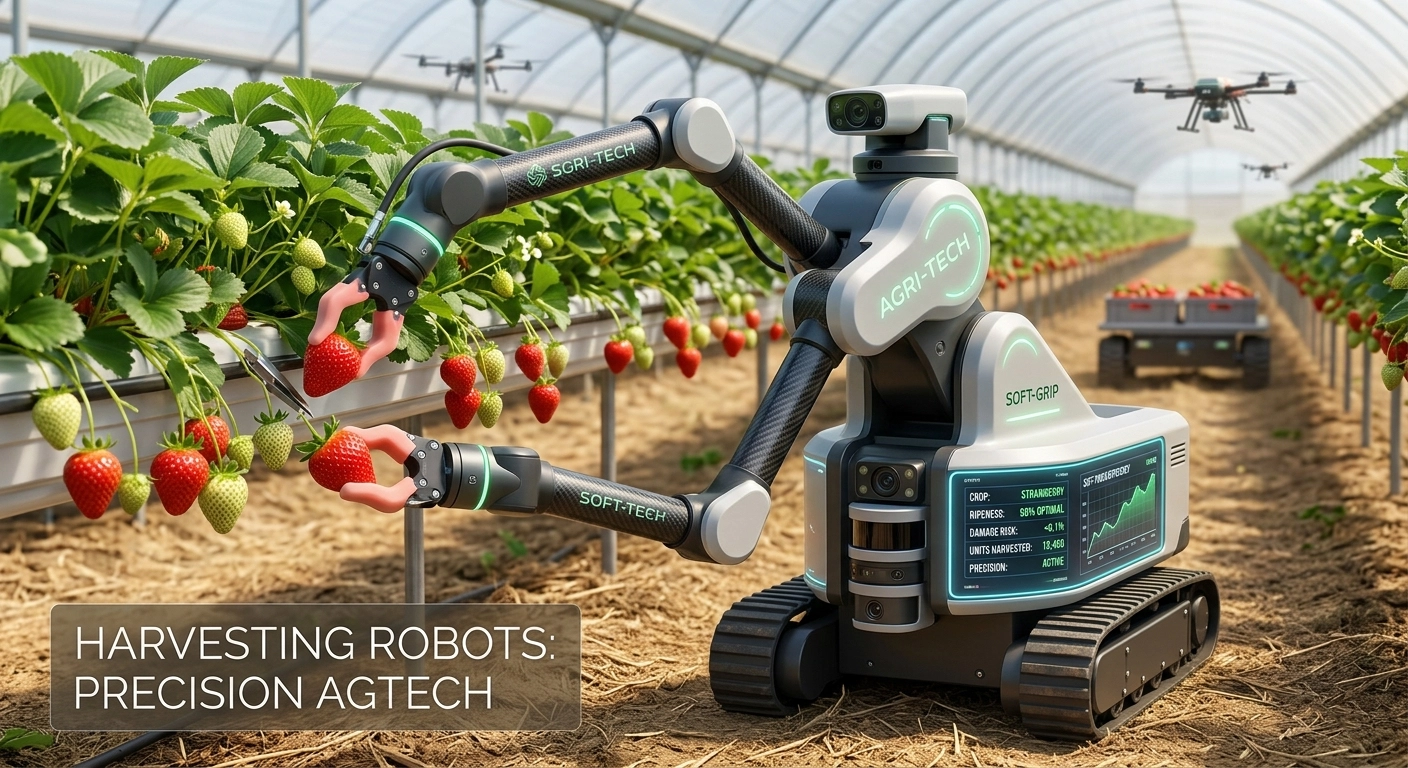
Let’s be honest: when you think of a farm, you probably picture a straw hat, a pair of worn-out boots, and some back-breaking labor under a scorching sun. It’s the classic “Old MacDonald” vibe. But if you stepped into a modern orchard today, you might hear a faint hydraulic hum instead of a farmer’s sigh.
Welcome to the revolution. We are living in the era of Harvesting Robots, and quite frankly, it’s about time.
For decades, the agricultural sector has been screaming for help. Labor shortages are at an all-time high, costs are skyrocketing, and—let’s face it—humans are pretty inconsistent at picking delicate fruit for twelve hours straight without bruising a few apples. Enter the silicon-brained, steel-armed saviors of the food chain. But can a machine really have the “gentle touch” of a human hand? Can it tell the difference between a ripe strawberry and a red pebble?
Stick around, because we’re diving deep into the world of Harvesting Robots, the tech that’s making sure your supermarket berries look like they belong in a photoshoot rather than a blender.
Why the sudden rush to automate?
If you’ve checked the news lately (or tried to hire a seasonal crew), you know the “labor crisis” isn’t just a buzzword; it’s a structural collapse. Younger generations are moving to cities, immigration laws are tightening, and the physical toll of manual harvesting is becoming a hard sell.
But it’s not just about having “enough” hands. It’s about the precision of those hands. When a human gets tired, they get sloppy. They squeeze a peach too hard. They miss the hidden bunch of grapes under the leaves. A robot? It doesn’t get tired. It doesn’t need a lunch break. And most importantly, it’s powered by AI that is increasingly becoming more observant than the human eye.
The Soft Touch: How Harvesting Robots Avoid the “Scratch”
The biggest hurdle for engineers wasn’t making a robot that could move; it was making a robot that wouldn’t turn a vineyard into a giant bowl of jam. This is where the magic of Harvesting Robots truly shines. We are moving away from cold, hard metal grippers and into the realm of Soft Robotics.
1. Computer Vision: The “Brain” Behind the Eye
Before a robot can pick a fruit, it has to see it. Modern harvesters use LiDAR, hyperspectral imaging, and 3D cameras to build a real-time map of the plant. They aren’t just looking for color; they are analyzing “reflectance.” They can determine the sugar content (Brix level) of a melon just by looking at the light bouncing off its skin. If it’s not perfect, the robot moves on. No more under-ripe fruit sitting in your fridge!
2. End-Effectors: The “Gentle” Fingers
The “hand” of the robot is called an end-effector. Some use vacuum suction cups that gently pull a berry from the vine. Others use 3D-printed silicone fingers that mimic the pressure of a human thumb. Some of the most advanced models don’t even touch the fruit’s surface—they use tiny high-speed blades to snip the stem, letting the fruit fall into a soft, cushioned hammock.
3. Machine Learning and Feedback Loops
Every time a robot misses a fruit or encounters an awkward angle, it learns. Through reinforcement learning, these machines share data across a cloud network. If a robot in California figures out a better way to pluck a stubborn avocado, a robot in Spain knows how to do it five minutes later.
Economic Impact: Are Harvesting Robots Stealing Jobs?
This is the question that always comes up in the comments section, right? “What happens to the workers?”
It’s a valid concern, but the reality is more nuanced. We aren’t replacing people who want these jobs; we are filling a void where the jobs are already empty. By integrating Harvesting Robots into the workflow, farms can shift their human capital toward more technical roles: robot fleet management, data analysis, and complex maintenance.
Moreover, these robots allow for “Continuous Harvesting.” Since they can work at night using infrared sensors, the harvest window is doubled. This means less food rotting in the fields and more profit for the farmer, which eventually stabilizes food prices for you and me at the checkout counter.
The Leaders of the Pack: Who’s Winning the Race?
Several companies are currently leading the charge in this $5 billion+ industry:
| Company | Specialization | Tech Highlight |
| Abundant Robotics | Apples | Vacuum-based suction picking. |
| Dogtooth Technologies | Strawberries | AI-driven ripeness grading on the fly. |
| Tevel Aerobotics | Fruit Orchards | Flying autonomous robots (drones) with tethered power. |
| Advanced Farm | Berries | High-speed, multi-arm picking platforms. |
Harvesting Robots and the Math of Efficiency (SEO Rank)
From a logistical standpoint, the shift to automation is a simple equation of efficiency. If we look at the “Math Rank” of a farm’s ROI (Return on Investment), the variables are clear:
ROI = {(Total Harvest Value \times Efficiency) – Operating Costs} / {Capital Investment}
Traditionally, “Efficiency” was limited by human fatigue and “Operating Costs” fluctuated with labor laws. Harvesting Robots turn these variables into constants. You know exactly how many units will be picked per hour, and the “Efficiency” coefficient approaches 99% . This predictability is why venture capital is pouring into AgTech.
What’s next for the “Bot-Farmer”?
We are heading toward a “Full-Stack” autonomous farm. Imagine a swarm of drones scouting for pests in the morning, followed by autonomous tractors weeding the rows, and finally, a fleet of Harvesting Robots coming in at 2:00 AM to pick the peak-ripeness produce while the world sleeps.
We are also seeing the rise of “Robot-as-a-Service” (RaaS). Small farmers who can’t afford a $500,000 machine can “rent” a fleet for the harvest season. This democratizes the tech, ensuring that it’s not just the “Big Ag” corporations that benefit from precision engineering.
Your Turn: Would you eat “Robot-Picked” fruit?
I want to hear from you guys. Does the idea of a machine handling your food feel “too sci-fi,” or are you just happy that your strawberries won’t be bruised and overpriced?
Some people argue that we’re losing the “soul” of farming. Others say that if a robot can do the “dirty, dull, and dangerous” work, we should let it. What do you think? Drop a comment below—I’ll be hanging out to chat about whether you think the future of food is silicon or soil.
Conclusion: The New Dawn of Agriculture
The transition to Harvesting Robots isn’t just an upgrade; it’s a necessity for a planet that is expected to host 10 billion people by 2050. We need to produce more food, with fewer resources, and less waste.
By utilizing computer vision that “sees” better than we do and mechanical hands that “feel” more delicately than ours, these robots are ensuring that the bridge from the farm to your table is shorter, faster, and much more efficient. So, the next time you bite into a perfectly ripe, unblemished peach, take a second to wonder: was this picked by a person, or by a very, very smart machine?
The future is ripe for the picking. Are you ready?
What do you think is the biggest challenge for robots in the field—is it the unpredictable weather or the sheer variety of plant shapes?