
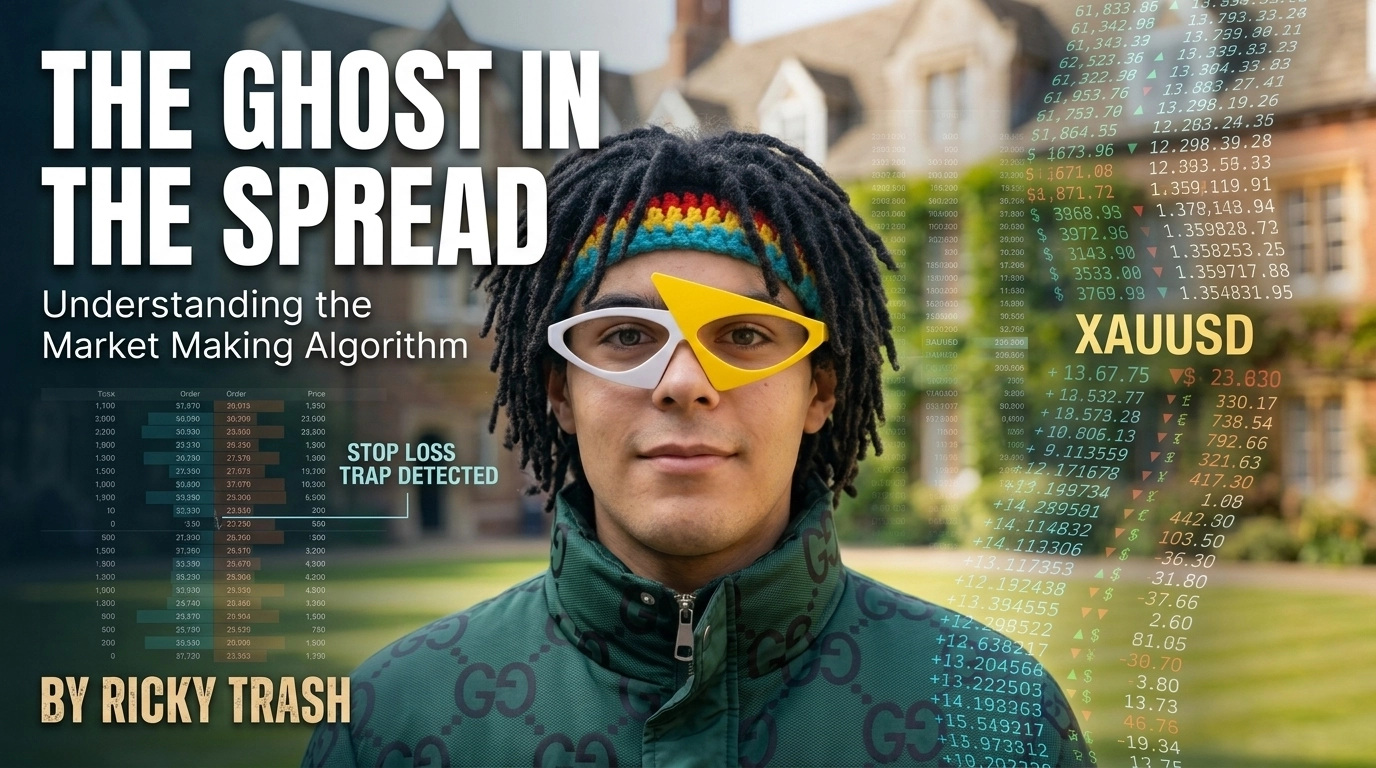
The Invisible Predator in Your Terminal
Have you ever had that eerie, gut-wrenching feeling? You’ve spent three hours analyzing the 15-minute chart on Gold (XAUUSD). You’ve identified the perfect support, the RSI is screaming “oversold,” and the price action looks like it’s ready to moon. You finally build up the courage, take a deep breath, and click that “Buy Market” button.
The millisecond—literally the microsecond—your order hits the tape, the price reverses. It’s like the market was waiting specifically for you to enter so it could go the other way. You aren’t being followed by a secret agent, and the CIA doesn’t care about your $200 account. But you are being watched. You are being hunted by the Market Making (MM) Algorithm.
In the “Interbank Matrix,” these Algos are the ghosts in the machine. They aren’t humans in suits sitting in a glass tower in Manhattan anymore; they are cold, calculating lines of code designed to provide “liquidity.” But here’s the reality check: they aren’t your friends. They are the house, and the house always wants its cut. If you want to stop being the “exit liquidity” for a high-frequency machine, sit down. We’re going deep into the belly of the beast.
1. The MM Mandate: The Spread is a Mandatory Tax
To understand the machine, you have to understand its purpose. At its core, a Market Maker has one primary job: to provide a two-sided quote. This means they must always offer a Bid (the price they are willing to buy from you) and an Ask (the price they are willing to sell to you).
The algorithm doesn’t care about the “fundamentals.” It doesn’t care if the Federal Reserve is hawkish or if Gold hits $3,000 or sinks to the center of the earth. It isn’t “investing” in the way you are. It is skimming. By capturing the Spread—that tiny gap between the buy and sell price—it prints money millions of times a day. Think of the MM as a toll booth on a bridge. It doesn’t care where the cars are going; it just cares that every car has to pay $1.00 to cross.
Ricky’s Reality Check: You pay a “convenience fee” every time you trade. The MM is the guy charging you $10 for a bottle of water at a Coachella concert because he’s the only one with a cooler. He doesn’t care if you’re thirsty; he just cares about the margin.
2. Inventory Risk: When the Machine Starts to Sweat
The biggest threat to an Algo—its “Kryptonite”—is Inventory Risk. Imagine a scenario where a sudden rumor breaks out. Everyone and their mother starts buying Gold at once. Because the Algo is a Market Maker, it is forced to take the other side of those trades to keep the market moving. This means the Algo ends up heavily Short while the rest of the world is Long.
If the price of Gold keeps skyrocketing, the Algo starts losing millions of dollars every second. This is the only time the machine “panics.” To save itself, the algorithm does two things:
- Price Manipulation (The Skew): It will instantly spike the “Ask” price to an unreasonable level. This makes buying too expensive for retail traders and makes selling more attractive, helping the Algo balance its books.
- The Offload: It uses HFT (High-Frequency Trading) to find someone else—another bank, another fund, or a bigger fish—to “dump” its losing position onto within microseconds.
If you see the price moving in one direction but the spread widening significantly, that’s the machine trying to offload its risk.
3. Detecting “Toxic Flow”: The Whale Alert
This is where the programming gets truly sophisticated. Modern Algos are designed to spot what insiders call “Toxic Flow.” No, it’s not literal poison. “Toxic Flow” refers to the footprint of Smart Money. When a massive whale—like a $50 billion hedge fund or a central bank—starts moving a position, they don’t do it all at once. They use “Iceberg orders” to hide their size. However, the MM Algorithm is trained to recognize the “weight” of these orders.
When the Algo realizes it’s about to be steamrolled by a real, institutional trend, it doesn’t try to fight. It protects itself.
- The Response: It “pulls liquidity.” It literally steps out of the way.
- The Result: This is why during high-impact news like NFP (Non-Farm Payrolls) or CPI, your spread jumps from 2 pips to 60 pips. The machine is essentially saying, “I’m not playing this game until the whale leaves the pool.” If you’re trading during these times, you aren’t trading against “the market”; you’re trading in a vacuum where the machine can charge you whatever it wants because there’s no competition.
4. Manufacturing Liquidity: The “Stop Hunt” Special
Here is the part that will make you want to throw your monitor out the window. When the market is quiet and “choppy,” the Algo gets bored. Boredom is bad for business because no volume means no spreads to collect.
To fix this, the machine manufactures a reason for you to trade. It creates “artificial” volatility to harvest Liquidity Clusters.
The Anatomy of a Stop Hunt:
- The Bait: The Algo allows the price to consolidate, creating a very “obvious” support level. Retail traders see this and place their Buy orders, putting their Stop Losses just a few pips below that line.
- The Fake-Out: The machine drives the price sharply downward, just far enough to “clip” those stops.
- The Harvest: When your “Buy” trade hits its Stop Loss, it becomes a Market Sell Order. Thousands of these sell orders hit the market at once.
- The Reversal: The Algo, which needs “Sell” orders to fill its own “Buy” orders, gobbles up all that panic-selling at a discount. Within minutes, the price teleports back to where it started, leaving you stopped out and confused.
Ricky’s Rule: If a chart pattern looks too “perfect” or “textbook,” it is almost certainly a trap set by the machine to harvest your lunch money. The machine knows exactly where your stop is because that’s where the most “liquidity” lives.
5. The B-Book Trap: Playing with Loaded Dice
If you are trading with a “low-tier” prop firm or a shady offshore broker, you might not even be interacting with the real Interbank Market. You are likely stuck in a “B-Book“ environment.
In a B-Book setup, the broker is the Market Maker. They don’t send your trades to the real world; they just keep them in their own internal database. In this scenario, the broker only makes money when you lose. They use specialized plugins to manipulate the “internal” feed. This is where “Asymmetric Slippage” comes into play:
- Winning Trades: You try to exit a winner, but the “price changes,” and you get filled at a worse price.
- Losing Trades: Your stop loss is hit with surgical precision, even if the price on other platforms didn’t quite touch that level.
They are essentially running a casino where the dice are weighted and the dealer can see your cards. If you’re wondering why your “perfect” strategy works on a demo account but fails on a B-Book prop firm, now you know.
6. How to Fight a Ghost (And Win)
You cannot beat a multi-million dollar algorithm at a game of speed. You will lose every time. Instead, you have to change the rules of the game. You have to stop acting like “Retail” and start thinking like a “Provider.”
A. Stop Using “Market Orders”
When you hit “Buy Market,” you are a “Liquidity Taker.” You are signaling to the machine that you are desperate to enter now. The machine rewards this desperation by giving you the worst possible price within the spread.
- The Solution: Use Limit Orders. When you use a Limit Order, you are technically a “Liquidity Provider.” You are telling the machine, “I will only buy at THIS price.” This puts you on the same side of the ledger as the banks.
B. Watch the “Mean” (The Rubber Band Effect)
Market Makers are designed to return the price to a state of equilibrium (The Mean). If you see a violent, parabolic move that isn’t backed by a major news event, it is likely a “Liquidity Sweep.” Don’t chase the move. Wait for the price to “snap back” to the mean. The Algo wants to bring it back so it can settle its inventory.
C. Respect the Session Clock
The MM Algorithms are most “tame” when there is high organic volume—specifically during the London and New York sessions. This is when there is enough “Real Money” (corporations and actual banks) to keep the Algos in check.
- If you trade during the Asian Session or the “Dead Hour” (between NY close and Asia open), the liquidity is paper-thin. In these times, the Algo has total control. It can move the price 50 pips just to hunt a single cluster of stops because there is no one there to stop it.
The Final Word: Are You the Hunter or the Bait?
The Market Making Algorithm isn’t an “evil” entity trying to ruin your life—it’s just a tool. It’s a vacuum cleaner designed to suck up every loose dollar in the spread. If you trade with high leverage, tight stops, and market orders during low-liquidity hours, you are essentially walking into the vacuum.
To survive in this game, you have to be invisible. You have to wait for the machine to finish its “harvest” before you enter. Let the Algo hunt the retail “weak hands” first. When the stop-run is over and the machine is “full,” that is when you strike.
What about you? Have you ever felt like the “Ghost in the Machine” was out to get you? Have you been “spread-sniped” right before a massive move? Let me know your horror stories in the comments—let’s expose these Algos together.
Disclaimer: Trading involves significant risk. This article is for educational and entertainment purposes only. Ricky Trash is not responsible for your blown accounts—only the machine is.