
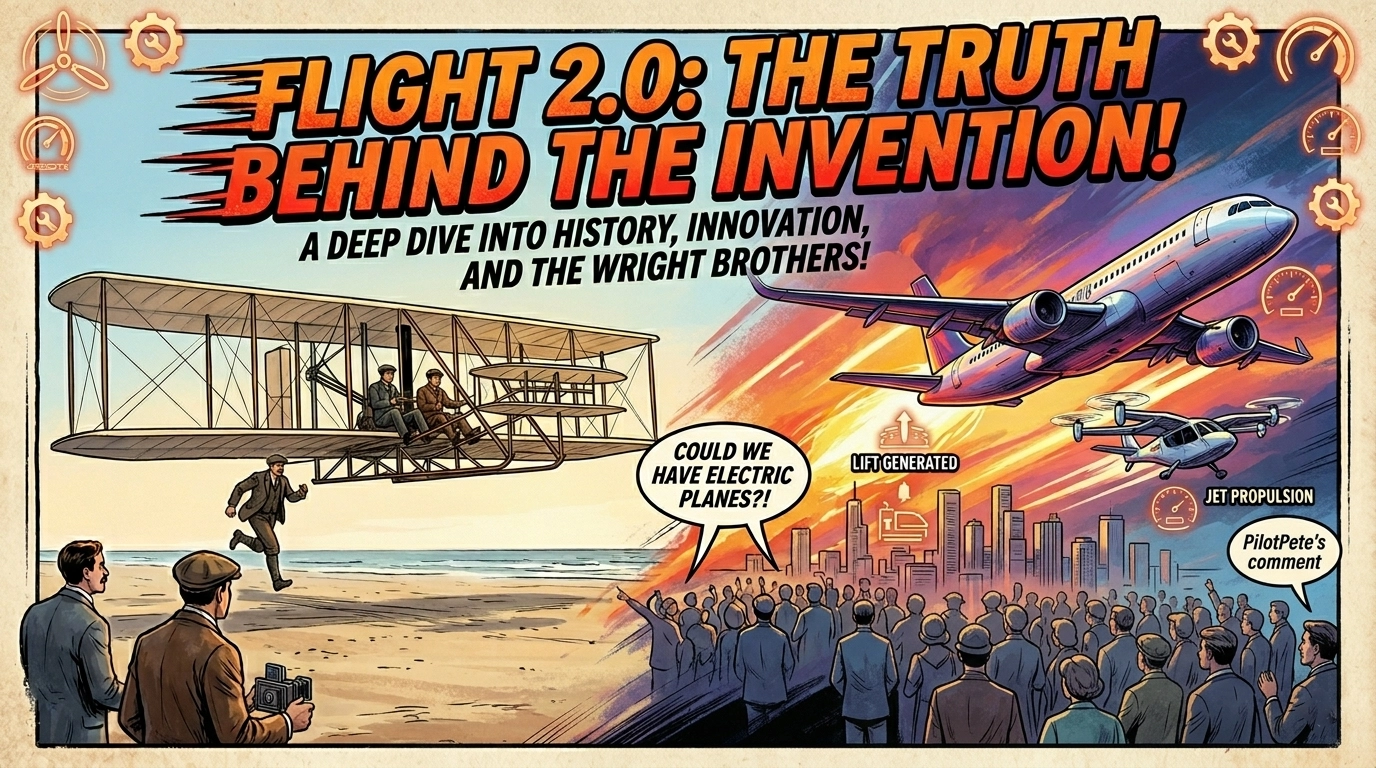
Listen up, legends! Ever looked at a 200-ton metal tube screaming through the sky at 500 mph and thought, “How did we get here?” Because let’s be real—humans weren’t built for this. We don’t have feathers, our bones aren’t hollow, and if we fall from more than ten feet, we break like a cheap toy.
But guess what? We did it anyway.
The story of the invention of the airplane isn’t just about engines and wings; it’s about absolute madmen who refused to accept that gravity was the boss of them. We’re talking about a journey from Leonardo da Vinci’s sketches to two brothers from Ohio who literally changed the map of the world.
Buckle up, because we’re going 0 to 100 real quick.
1. The “Dreamer” Phase: When We Thought Flapping Was the Move
Before we had the Wright brothers, we had a lot of guys jumping off towers with homemade wings. Spoiler alert: It didn’t go well.
The O.G. Visionary: Leonardo da Vinci
Back in the 15th century, Leo was sketching “ornithopters”—machines designed to fly by flapping wings like a bird. He had the spirit, but he lacked one major thing: The Internal Combustion Engine. Without a power source stronger than a human’s biceps, those sketches remained just beautiful pieces of paper.
Sir George Cayley: The “Grandfather of Aviation”
Fast forward to the early 1800s. This British engineer realized flapping was a dead end. He identified the four forces of flight that every pilot (and every gamer playing Flight Simulator) knows today:
- Lift
- Weight
- Thrust
- Drag
He built the first successful glider, proving that fixed-wing flight was the future. If you’re reading this while sipping a soda in Seat 12B, say “Thanks, George.”
2. The Wright Stuff: Why Two Bicycle Mechanics?
You’d think the invention of the airplane would come from a government lab or a billionaire. Nope. It came from Orville and Wilbur Wright, two brothers who ran a bike shop in Dayton, Ohio.
Why does this matter? Because bikes are all about balance and control.
Most people trying to fly back then were focused on “inherent stability”—making a plane that wouldn’t tip over. The Wrights knew better. They knew a plane needed to be unstable enough to be steered. They invented “wing warping” (the ancestor of ailerons) to tilt the wings and turn the craft.
Pop Quiz for the Comments: If you were living in 1903, would you have climbed into a wooden glider held together by spit and prayers? Let me know below! 👇
3. Kitty Hawk: The Moment Everything Changed
Why Kitty Hawk, North Carolina? Because the Wrights needed three things:
- Steady winds to lift the wings.
- Soft sand for the inevitable crashes (and there were many).
- Privacy from the “haters” and the press.
December 17, 1903: The 12 Seconds That Shook the World
Picture this: It’s freezing cold. The wind is whipping at 27 mph. Orville climbs into the Wright Flyer. He lays flat on his stomach. He cranks the engine—a custom-built 12-horsepower beast they made themselves because no car company would help them.
The propellers spin. The machine slides down the rail. And then… LIFT OFF.
- Distance: 120 feet.
- Time: 12 seconds.
- Speed: Basically a brisk jog.
It wasn’t a trans-Atlantic flight, but it was the first time a powered, controlled, man-made machine left the earth and landed on its own terms. By the end of that day, Wilbur managed a flight of 59 seconds, covering 852 feet.
Boom. History made.
4. The “Secret” Tech: What Made It Actually Work?
You want the technical “trash talk”? Most people fail to realize the Wrights were world-class scientists. They built their own wind tunnel out of a starch box to test wing shapes.
They realized that a propeller isn’t just a fan—it’s a rotating wing. That realization alone was a massive “I.Q. diff” compared to their competitors. While others were trying to use “rowing” motions in the air, the Wrights were calculating lift coefficients like absolute bosses.
5. From 12 Seconds to the Edge of Space
The evolution after 1903 was like a wildfire.
- 1914-1918: WWI turned planes from “neat toys” into terrifying weapons and reconnaissance tools.
- 1927: Charles Lindbergh flies solo across the Atlantic. Total rockstar move.
- 1947: Chuck Yeager breaks the sound barrier in the Bell X-1. Adrenaline levels: Infinite.
- 1969: We literally flew a “plane” (the Lunar Module) onto the moon.
Think about that. In 66 years—less than a human lifespan—we went from a sandy beach in North Carolina to the Sea of Tranquility on the Moon. That is the power of human obsession.
6. Why You Should Care Today
The invention of the airplane didn’t just give us vacations in Bali. It shrunk the planet. It meant that a doctor in London could help a patient in Africa. It meant that your “Next Day Delivery” actually shows up the next day.
But more importantly, it proves that the “experts” aren’t always right. In 1903, the New York Times actually wrote that a flying machine might be possible in 1 to 10 million years. The Wright brothers did it nine weeks later.
The Lesson: Never let a “fact” get in the way of a great idea.
7. Interactive Zone: Let’s Debate! 🗣️
I want to hear from the community. Aviation is moving into the “Electric Vertical Take-Off” (eVTOL) era.
- Question 1: Do you think we’ll all have “flying cars” in the next 20 years, or is it just hype?
- Question 2: If you could travel back to Kitty Hawk for those 12 seconds, what would you say to Orville Wright?
Drop your thoughts in the comments! I’m reading all of them.
Summary Table: The Milestones of Flight
| Year | Milestone | Why it matters |
| 1485 | Da Vinci’s Sketches | The birth of the dream. |
| 1804 | Cayley’s Glider | Established the physics of flight. |
| 1890s | Otto Lilienthal | The “Glider King” who proved humans can glide. |
| 1903 | The Wright Flyer | The first powered, controlled flight. |
| 1939 | The Heinkel He 178 | The first jet-powered aircraft. Faster than ever. |
| 1969 | Boeing 747 | “Jumbo Jet” makes global travel affordable for everyone. |
Final Thoughts: Stay Fly
The invention of the airplane is the ultimate “underdog” story. It’s about grit, bicycle grease, and the refusal to stay grounded. Next time you’re stuck in a middle seat between two snorers, just remember: you are witnessing a miracle that took 5,000 years to figure out.
Stay curious, stay bold, and keep looking up.