
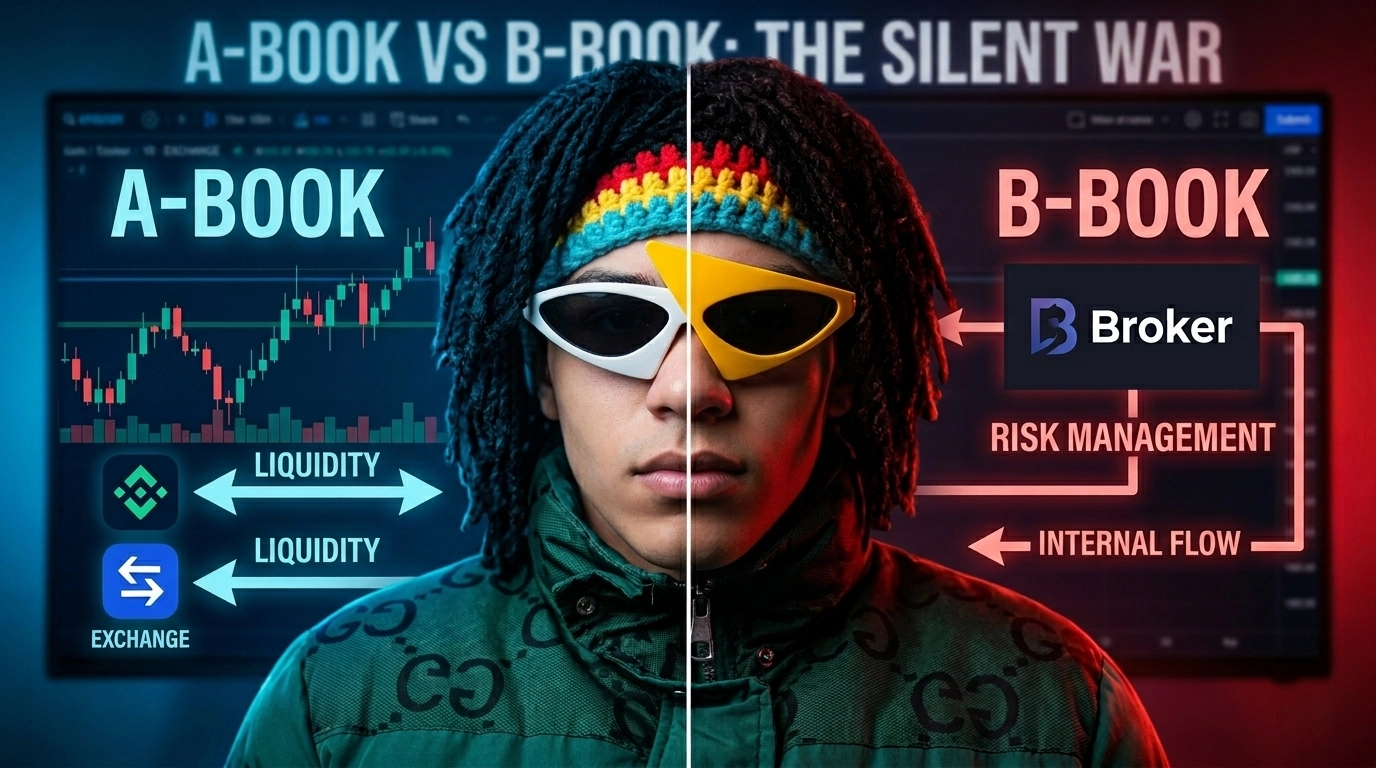
What’s up, my digital engineers? Ricky Trash here.
Let’s talk about something your broker hopes you never google. You’ve spent weeks mastering the IPDA Algorithm, months studying liquidity sweeps, and you’ve finally started generating that sweet, sweet “Grape Juice” (our term for those pure, hard-earned profits). But then, something feels off. Your orders get delayed. Your slippage is insane. Your account gets flagged.
Why? Because you might be in the middle of a silent war.
Today, we are stripping away the marketing fluff and exposing the plumbing of the brokerage world. We’re diving into the A-Book vs B-Book models. If you don’t know which one your broker is using, you aren’t a trader—you’re a gambler playing in a rigged casino.
Grab your glass of “Grape Juice,” stay focused, and let’s break down the 1,500-word truth.
1. The Brokerage Matrix: Where Does Your Order Go?
When you click “Buy” on your MT4 or MT5, you think your order goes straight to the global market.
Spoiler alert: Most of the time, it doesn’t.
A broker is essentially a bridge. But depending on their business model, that bridge either leads to the Interbank Market (The Promised Land) or a Dark Room in their basement where they are waiting to take your money.
2. The A-Book Model: The Honest Middleman (STP/ECN)
In the A-Book model, the broker acts as a true bridge. They take your order and instantly pass it to a Liquidity Provider (LP)—these are the Tier 1 banks we talked about in our Interbank deep-dive.
How it Works:
- Entry: You buy 1 lot of Gold.
- Transmission: The broker sends that 1 lot to the Interbank market.
- Profit: The broker makes money by adding a small “Markup” to the spread or charging a commission.
Why A-Book is “Clean”:
The broker’s interest is aligned with yours. They want you to trade more, win more, and stay alive longer because they make money every time you click a button. They don’t care if you win a million dollars—the bank pays you, not them. This is the path for anyone looking for long-term “Grape Juice” stability.
3. The B-Book Model: The “Market Maker” Casino
Now, let’s talk about the B-Book. This is where things get dirty. In this model, the broker never sends your order to the real market. They keep it “in-house.”
They are the counterparty to your trade. When you buy, they are the seller. When you lose $1,000, they profit $1,000. It is a direct zero-sum game between you and the person holding your money.
The Stats that Fuel the B-Book:
Brokers know that 90% of retail traders lose their money within 90 days. So, instead of paying banks for liquidity, they decide to “bet against you.” They keep your money in their pocket, hoping you’ll blow your account so they can keep it all.
The Conflict of Interest:
If you start winning—if you start extracting real “Grape Juice” using the Ricky Trash strategies—a B-Book broker sees you as a “Toxic Trader.” You are literally taking money out of their payroll. This is when the “glitches” start happening.
4. The Silent Weapons of the B-Book Broker
Since a B-Book broker loses money when you win, they have a “toolkit” to slow you down:
- Artificial Slippage: You want to enter at 1.1000? They give you 1.1005. Those 5 pips go straight to their bottom line.
- Requotes: “Price has changed.” They won’t let you enter a good position because they know it’s a winner.
- Stop Loss Hunting: A B-Book broker can manipulate their internal feed to trigger your stop loss, even if the real Interbank price never touched it.
- Delayed Withdrawals: When you try to withdraw your “Grape Juice,” they suddenly need “extra verification” for three weeks. They hope you’ll get frustrated and trade that money back into their hands.
5. The Hybrid Model: The “Sorting Hat”
Most big brokers today use a Hybrid Model. They use an AI algorithm to “profile” you the moment you sign up.
- The “C-Group” (The Sheep): If you have a small account and no strategy, they put you in the B-Book. They know you’ll lose, so they keep your money.
- The “A-Group” (The Sharks): If they see you are using Order Blocks and growing your account, they move your orders to the A-Book because they don’t want to risk their own capital against a smart trader.
6. Comparison Table: A-Book vs. B-Book
| Feature | A-Book (STP/ECN) | B-Book (Market Maker) |
| Execution | Direct to Interbank Market. | Internal (Inside the House). |
| Profit Source | Commissions & Spread Markup. | Trader Losses (Your loss = Their win). |
| Conflict of Interest | None. They want you to win. | High. They want you to lose. |
| Execution Speed | Real-market dependent. | Instant (but potentially artificial). |
| Best For | Professional & Profitable Traders. | Beginners (with caution). |
| Grape Juice Flow | Clean and Consistent. | Often filtered or blocked. |
7. How to Spot a “Dirty” B-Book Broker
Listen closely, because this could save you thousands. A B-Book broker usually:
- Offers Insane Bonuses: “Deposit $100, get $500 bonus!” Real banks don’t give free money.
- Extreme Leverage (1:2000): They want you to blow your account instantly.
- No Regulation: They are based in offshore islands with no oversight.
8. Conclusion: Be the Hunter, Not the Prey
The war between you and the broker is real, but it’s a war you can win. By understanding the A-Book vs. B-Book dynamics, you take the first step toward becoming a truly independent digital engineer.
At Ricky Trash, we don’t just teach you how to read a chart; we teach you how the plumbing of the financial world works. Don’t be the trader who complains about “manipulation.” Be the trader who is so good that the broker is forced to move you to the A-Book to protect themselves.
Keep your strategy sharp. Keep your “Grape Juice” flowing.
What’s your broker story? Have you ever felt the B-Book “sting”? Drop a comment below. Let’s clean up this industry one trade at a time.
Stay sharp. Stay cynical. Stay Trash.
— Ricky Trash
Disclaimer: This article is for educational and branding purposes. Trading involves significant risk. I am a content creator, and a strategist—not your financial advisor. Use your brain.
One Reply to “A-Book vs B-Book: The Silent War Between You and Your Broker”