
Welcome back to the world of Ricky Trash. If you’ve been following my journey, you know we don’t just chase “trends”—we chase asymmetric opportunities. We look for where the smart money is moving before the rest of the world catches on.
Today, we’re stepping away from the charts, the SEO backlinks, and the dropshipping product research to look at something much more… grounded. Literally.
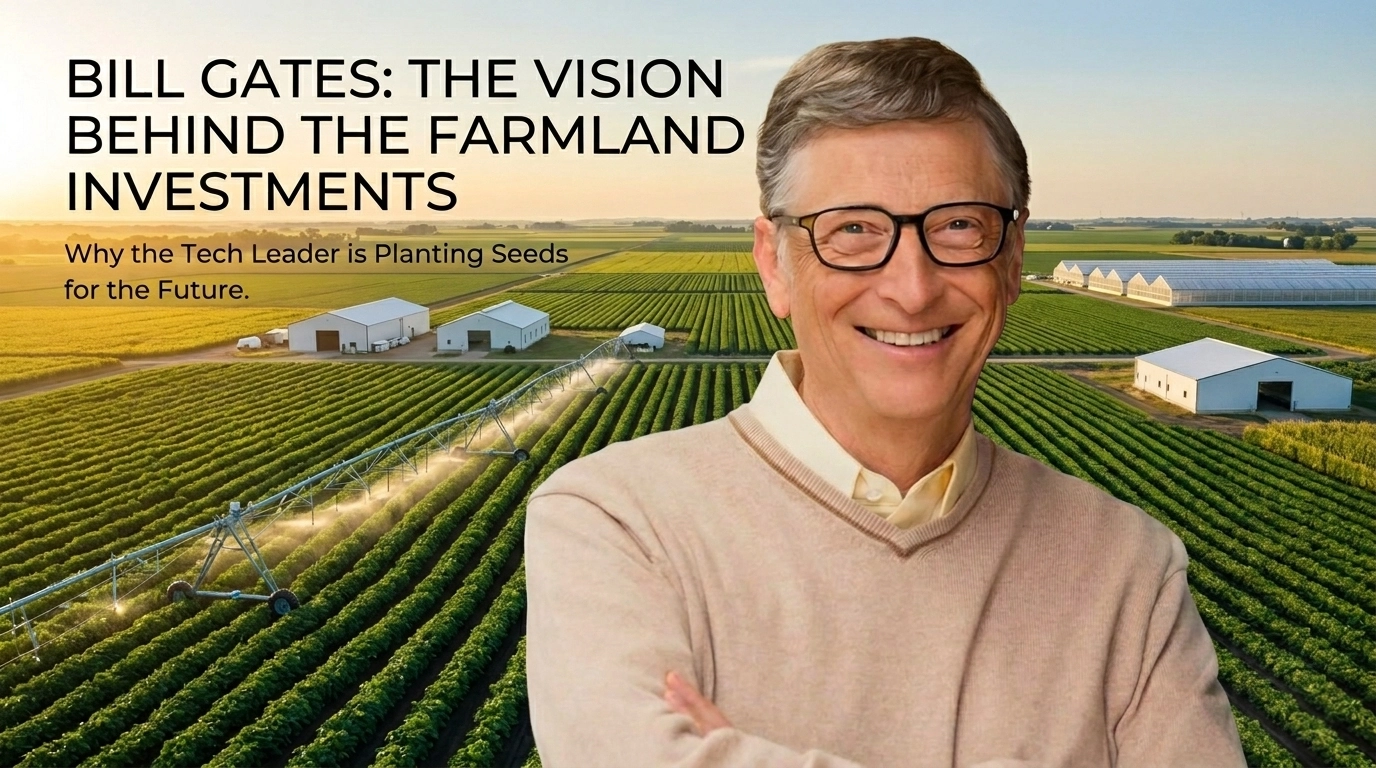
Why is Bill Gates—the man who built an empire on software and invisible code—now the largest private owner of farmland in the United States? With over 270,000 acres in his portfolio, he isn’t planning a retirement in a tractor. He is executing a masterclass in Capital Farming.
In this exclusive breakdown, we’re going to analyze the “why,” the “how,” and most importantly, how you can apply this “owner mindset” to your own digital and physical ventures.
1. The Macro-Logic: Land as a “Wealth Bunker”
In the world of investing, we often talk about Inflation Hedges. When the government prints more money, the purchasing power of your dollar drops. But you know what doesn’t lose its utility? A field of wheat.
The Inflation Shield
Farmland is one of the few assets that has a direct correlation with inflation. When the cost of living goes up, food prices go up. When food prices go up, the value of the land that produces that food increases proportionally. For a massive fund like Cascade Investment (which manages Gates’ wealth), farmland acts as a massive shock absorber for the portfolio.
Built-in Scarcity
As I always say in our SEO discussions: High demand + Low supply = Profit. The world population is skyrocketing toward 10 billion. Meanwhile, we are losing arable land to urbanization and climate degradation. Bill Gates is playing a supply-and-demand game that is mathematically impossible to lose in the long run. They aren’t making any more land, but they are making more people.
2. Agri-Tech: The “Silicon Valley” of Soil
Bill Gates isn’t just a landlord; he’s a tech visionary. He views these thousands of acres as a beta-testing ground for the future of humanity. This is where the “Ricky Trash” tech-enthusiast side gets excited.
He is investing in what we call Agri-Tech:
- AI-Driven Precision Farming: Using satellite imagery and ground sensors to monitor crop health down to the individual plant.
- Smart Irrigation: Reducing water waste by 40% through automated systems that only “drink” when the soil needs it.
- Genetics and Seed Science: Developing crops that can survive the harsh realities of a changing climate.
By applying technology to the land, he increases the “Yield per Acre.” In business terms, he is increasing his ROI by optimizing the manufacturing process of the earth itself.
3. Comparison: Traditional Farming vs. Capital Farming
To truly understand this shift, look at the data. Most people think of farming as a struggle against nature. For the elite, it’s a struggle for Asset Optimization.
| Feature | Traditional Farming | Capital Farming (The Gates Model) |
| Primary Goal | Seasonal Profit (Survival) | Long-term Asset Appreciation |
| Income Stream | Selling Crops at Market Price | Land Leasing + Carbon Credits + Tech Licensing |
| Technology | Mechanization (Tractors) | Digitization (Big Data, AI, Bio-Tech) |
| Risk Profile | High (Weather & Pest Dependent) | Managed (Diversified across climates & regions) |
| Time Horizon | Short-term (Harvest to Harvest) | Generational (Decades/Centuries) |
4. The “Carbon Credit” Play: Making Money from Thin Air
This is a secret many beginner investors miss. Modern farming isn’t just about corn and soy; it’s about Carbon Sequestration.
As global regulations on carbon emissions tighten, big corporations (Airlines, Tech Giants, Manufacturers) need to buy “Carbon Credits” to offset their pollution. Well-managed farmland absorbs CO2. Bill Gates can essentially “sell the air” above his farms to other companies. It’s a recurring, passive revenue stream that requires almost zero overhead once the systems are in place.
That is Smart Money Concepts (SMC) at the highest level.
5. Why This Matters to YOU (The Digital Entrepreneur)
You might be thinking, “Ricky, I’m trying to get my first AdSense check, why are we talking about 200,000 acres?”
Because Wealth is a Mindset, not just a number.
From Digital to Physical
The “Ricky Trash” strategy has always been: Earn fast in the digital world, and store safely in the physical world. Whether you’re running a WordPress blog or a dropshipping store, your goal should be to convert those digital “pixels” into “bricks” (or in this case, “dirt”).
The Asset Portfolio
Bill Gates doesn’t keep all his eggs in Microsoft stock. He diversifies. If you have a successful niche site, don’t just start a second one. Look for an asset that has Zero Correlation with Google’s algorithm updates. Farmland doesn’t care about a “Helpful Content Update.” It only cares about the sun and the rain.
6. The Ethical Debate: New Age Feudalism?
We have to keep it real here. There is a lot of pushback. Critics argue that when billionaires buy up all the land, they drive prices up so high that young, local farmers can’t afford to start their own businesses.
Is Bill Gates a “Savior” trying to fix the food system, or is he a “New Age Lord” collecting rent from the world? In the game of capitalism, the line is often blurry. As investors, we must observe these movements to understand where the power—and the profit—is shifting.
7. How to Start (Even Without a Billion Dollars)
You don’t need to be a billionaire to start your “Capital Farming” journey. Here is how the “average” entrepreneur can get a piece of the pie:
- REITs (Real Estate Investment Trusts): There are specialized stocks that own nothing but farmland. You buy a share, and you get a dividend.
- Crowdfunded Farmland: Platforms now allow you to pool money with others to buy a specific farm in places like Iowa or Australia.
- The Digital Equivalent: Build “Digital Land.” A high-authority domain name is the “Farmland” of the internet. It’s scarce, it produces “yield” (traffic), and its value grows over time.
Final Thoughts & Interaction: What’s Your Move?
Bill Gates is showing us that the future isn’t just in the “Cloud”—it’s in the Ground. He is hedging against a volatile future by owning the most fundamental resource on the planet.
As we scale our blogs, our stores, and our trading accounts, let’s not forget the ultimate goal: Owning assets that don’t need us to work for them.
Now, I want to hear from the community:
- If you hit a $1M profit this year, would you buy Bitcoin, a Luxury Penthouse, or 100 Acres of Farmland?
- Do you think tech-driven farming is the solution to climate change, or is it just another way for the 1% to control the world’s resources?
Drop your comments below. I’m checking every single one—let’s get the discussion going!
Stay hungry, stay smart, and keep building.
— Ricky Trash