
What’s up, digital engineers? Ricky Trash here.
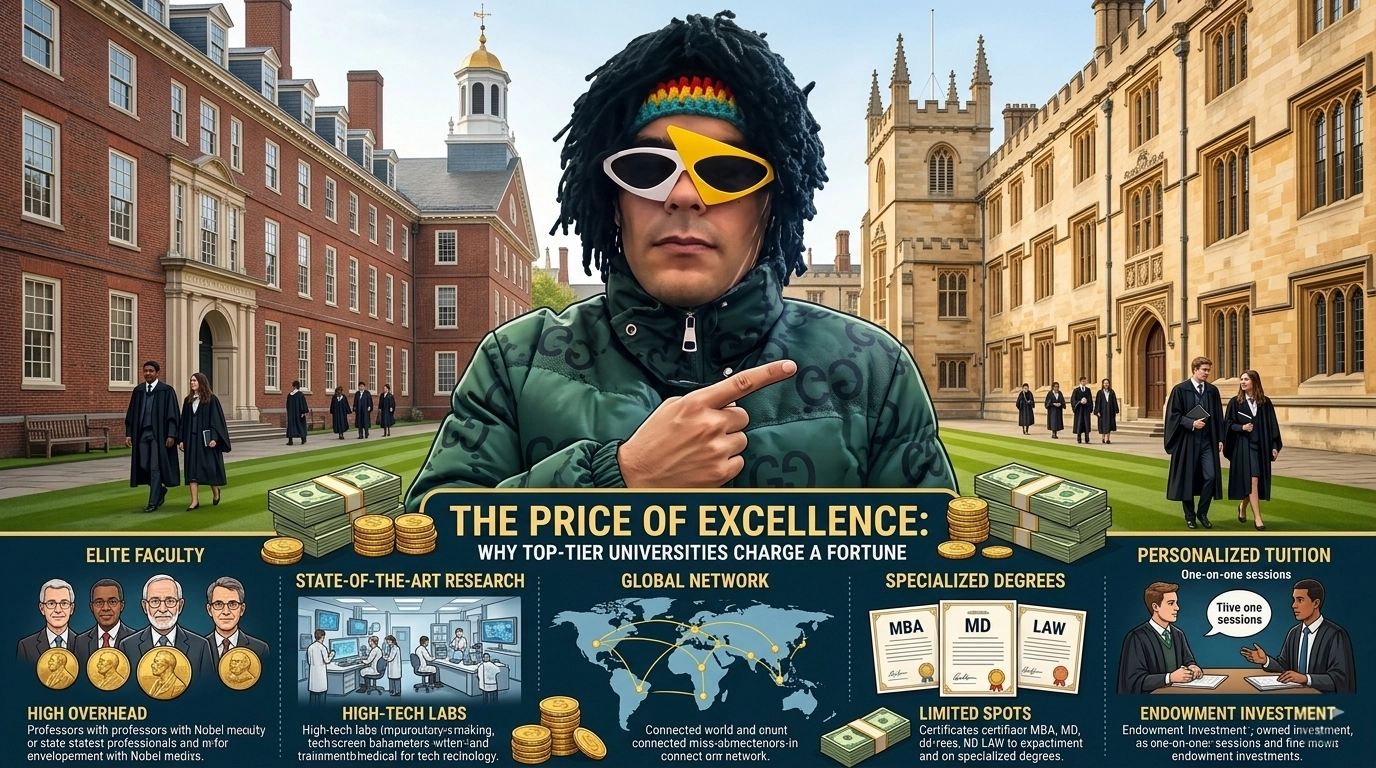
Let’s talk about a reality that makes most people’s heads spin: the cost of education in the US and the UK. If you want to become a doctor at Harvard or a specialist at Oxford, you aren’t just looking at a degree; you’re looking at a debt that could buy a small island.
Why? Is it just corporate greed? Is it a broken system?
While it’s easy to blame “The Man,” the truth is much more strategic. Today, we are going deep into the Engineering of Education about universities charge . We’re discussing why high tuition fees in fields like Medicine, Law, and Advanced Engineering aren’t just prices—they are Filters. They are tools used to maintain the balance of the labor market, ensure job availability, and reserve high-stakes fields for those who truly value the grind.
Grab your notebook. We’re about to dismantle the economics of the elite classroom.
1. The Equilibrium of Supply and Demand ( Universities Charge )
In the world of Ricky Trash, we look at everything as an algorithm. The job market is no different.
Imagine if medical school was free and open to everyone without any financial barrier. We would have a massive influx of medical graduates. While that sounds good on paper, basic economics tells us what happens next: Saturation. If you have 1,000 doctors for every 1 patient, the value of a doctor drops to zero. Salaries plummet, job security vanishes, and the “prestige” of the profession—which is what drives excellence—is destroyed. High tuition acts as a natural “supply-side” regulator. It ensures that the number of people entering the field is somewhat proportional to the economy’s ability to absorb them at a high salary level.
2. The Filter of Intent: The “Sacrifice” Metric
Let’s be real: Medicine, Aerospace Engineering, and High-Stakes Law are brutal. These aren’t just “jobs”; they are lifestyles that require 80-hour weeks and extreme mental fortitude.
Top universities in the US and UK use high fees to test a student’s Intent. When a student (or their family) invests $300,000 in a medical degree, that student isn’t there to “find themselves” or “hang out.” They are there to win.
The high cost ensures that these seats are filled by individuals who treat the study with the gravity it deserves. It filters out the casual seekers and leaves only the committed. In a field like Medicine, where a single mistake can cost a life, you want the person who valued their education enough to sacrifice everything for it.
3. High-Octane Infrastructure: You Get What You Pay For
Teaching a student History requires a library and a laptop. Teaching a student Robotic Surgery or Quantum Computing requires multi-million dollar laboratories, cadavers, supercomputers, and professors who are literally the “Brains of the Nation.”
The operating costs of top-tier US and UK universities are astronomical.
- US Universities (The Private Model): They invest billions in R&D. Your tuition pays for the world-class researcher who is discovering the next cure for cancer while teaching you biology.
- UK Universities (The Prestige Model): Even with government caps, the specialized fees for international students fund the centuries-old infrastructure and the global networks that give the degree its “Power.”
4. Protecting the Professional Ecosystem (Job Security)
A degree from a top UK or US university is a “Membership Card” to an elite club. By keeping the barrier to entry high, these institutions protect the “Brand” of the profession.
Take Law or Architecture as examples. If these fields become oversaturated due to low entry barriers, the professional ecosystem collapses. Unemployment among graduates leads to social instability. By maintaining a high “Cost of Entry,” the system ensures that those who graduate are almost guaranteed a high-paying position that allows them to pay back their investment. It is a self-sustaining cycle of high value and high reward.
5. Examples Beyond Medicine: Where the “Filter” is Active
Medicine is the obvious one, but the “High-Fee Filter” exists in other strategic niches:
- MBA Programs (The Business Elite): Why does a Harvard MBA cost $150k+? It’s not just the classes; it’s the Network. The fee ensures you are surrounded by people who are equally invested in high-level success.
- Aviation & Aerospace: Training a pilot or a satellite engineer involves massive liability and expensive equipment. The fees reflect the risk and the specialized job market waiting on the other side.
- Advanced STEM in the UK: Specialist engineering degrees at Imperial College London are priced to attract the global “Sharks”—the students who will go on to lead the industrial engineering of the future.
6. The “Social Balance” Argument
There is a social engineering aspect here as well. If every single person moved toward “High Prestige” degrees because they were cheap, who would build the digital brands? Who would handle the creative industries? Who would run the trades?
The cost of education directs the flow of human capital. It forces people to weigh their options. Many talented individuals choose different paths—like digital entrepreneurship or specialized tech—because the “ROI” (Return on Investment) of a $400k medical degree doesn’t make sense for them. This creates a balanced society where talent is distributed across various sectors, rather than everyone clumping into one or two “Gold Star” professions.
7. The Global “Brain” Competition
We must also look at the Soft Power of the US and UK. These nations use their universities as “Global Magnets.”
By charging high fees, they ensure they are attracting the wealthiest and most talented minds from across the globe. These students bring capital into the country during their studies and often stay to contribute to the nation’s “Industrial Engineering” or “Economic Brain.” It’s a strategic win for the host country.
8. Conclusion: The Price of the “Premium” Life
At Ricky Trash, we believe in seeing the world for what it is—a series of systems designed for efficiency.
High university fees in specialized fields are not just about the money. They are about Equilibrium. They ensure that our doctors are committed, our lawyers are elite, and our job markets aren’t flooded with overqualified, underpaid graduates.
Does it make it harder? Yes. But as we always say: The harder the filter, the more valuable the prize. If you want to be part of the elite, you have to appreciate the value of the “Seat” you are taking. Education is a high-stakes investment, and in the US and UK, they make sure you never forget that.
Stay sharp. Stay focused. And always value your “Grape Juice”—whether it’s profit from a trade or the knowledge from a world-class degree.
— Ricky Trash