
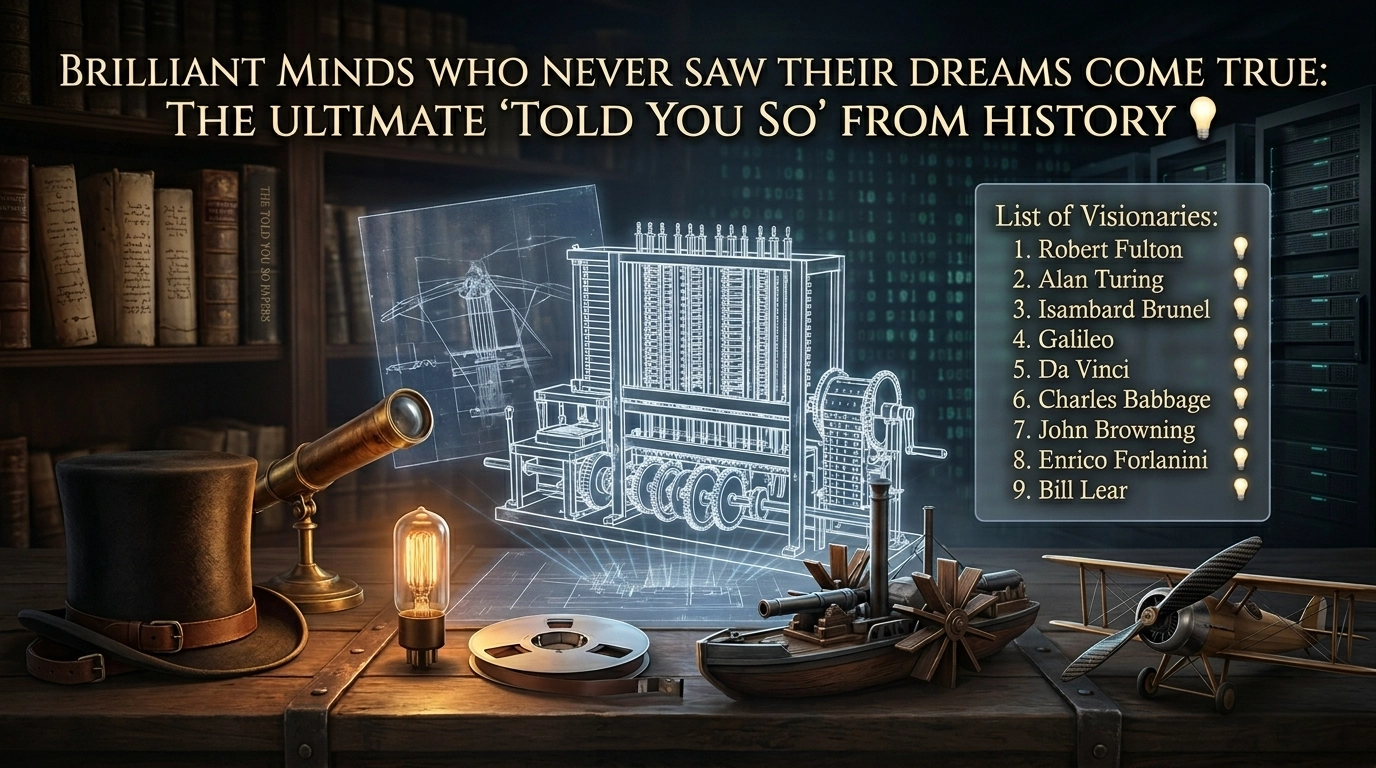
Ever feel like you’re shouting into a void? Like you’ve got a billion-dollar idea, but the world is too busy arguing over cat memes or the latest TikTok drama to notice? Well, welcome to the club. But don’t worry, you’re in elite company. History is basically a giant graveyard of geniuses who spent their entire lives grinding, sweating, and losing sleep over visions that the rest of the world thought were “crazy.”
The tragedy? Most of these legends died before they ever got to see their “crazy” ideas change the world. They were the ultimate beta-testers for a future they never got to log into. We’re talking about the OGs of innovation who were playing 4D chess while the rest of the world was playing checkers.
Grab your coffee (or your energy drink), because we’re about to deep-dive into the lives of nine brilliant minds who imagined the future but never got the chance to live in it.
1. Robert Fulton: The Man Who Wanted to Make War Obsolete (With a Steam Monster) 🚢
Let’s talk about Robert Fulton. Most people remember him as “the steamboat guy.” And sure, he made the Clermont a hit, but Fulton wasn’t just looking to give people nice river cruises. He was a visionary who saw the ocean as a battlefield that needed a serious upgrade.
Enter the Demologos (later called Fulton the First). In the early 1800s, naval warfare was all about wooden ships, sails, and praying for a good breeze. Fulton looked at that and said, “Nah, we can do better.” He designed a floating fortress—the world’s first steam-powered warship. It was a twin-hulled beast with a paddle wheel protected in the center, designed to be immune to wind conditions and capable of carrying massive cannons.
Fulton’s dream wasn’t just about winning a war; he actually thought that by creating such a terrifyingly powerful weapon, he would make naval warfare so one-sided that nations would stop fighting altogether. Talk about an optimist.
The Heartbreak: Fulton spent his final years obsessed with this project. But in February 1815, while walking home across the frozen Hudson River, he caught a nasty cold that turned into pneumonia. He died at 49, just months before the Demologos was finished. The ship was eventually launched and it worked—it was a marvel of engineering. But because the War of 1812 ended right around the same time, it never saw a single day of combat. Fulton died before the launch, and his “peace-making” monster ended up as a floating barracks before blowing up in an accidental explosion years later.
2. Alan Turing ( The Brilliant minds ): The Father of the Computer Who Died in the Dark 💻
If you’re reading this, you’re using a descendant of Alan Turing’s brain. Turing wasn’t just a “brilliant minds”; he was a human cheat code. During WWII, he was the guy who broke the “unbreakable” Enigma code, likely shortening the war by years and saving millions of lives. But after the war, he wasn’t looking for a vacation. He was looking for the ACE (Automatic Computing Engine).
While other early computer designers were thinking about big calculators, Turing was thinking about brains. His design for the ACE was the first true blueprint for a high-speed, general-purpose digital computer. It was elegant, fast, and lightyears ahead of what the Americans were building at the time.
The Heartbreak: Turing didn’t just struggle with technology; he struggled with a society that was tragically small-minded. Instead of being hailed as a national hero, he was persecuted for his personal life. The ACE project was bogged down by slow-moving bureaucracy and a lack of funding. Turing left the project frustrated, and before a full-scale version of his machine could be completed, he died in 1954 under tragic circumstances. He never got to see the digital revolution. He never saw a smartphone, the internet, or AI. He planted the seeds for the modern world and was forced out of the garden before they even sprouted.
3. Isambard Kingdom Brunel: The Rockstar in a Top Hat 🌉
If engineering had a “main character,” it was Isambard Kingdom Brunel. The man was a walking vibe—huge top hats, constant cigars, and an ego big enough to match his massive projects. He built railways, steamships, and tunnels, but the one project that haunted him was the Clifton Suspension Bridge.
Brunel won the competition to design the bridge when he was just 24 years old. He imagined a bridge that defied gravity, hanging over the Avon Gorge in Bristol like a piece of art. It was bold, it was beautiful, and it was… incredibly expensive.
The Heartbreak: Work started in 1831, but it was plagued by riots, lack of cash, and endless delays. Brunel spent his whole life trying to get it finished, but he kept getting distracted by other “minor” projects (like building the largest ship in the world). He died of a stroke in 1859 at the age of 53. At the time of his death, the bridge was nothing but two lonely stone towers and a bunch of abandoned iron. His fellow engineers eventually finished it as a tribute to him, using chains from another one of his demolished bridges. Today, it’s the symbol of Bristol, but the man who dreamed it never got to walk across it.
4. Galileo Galilei: Seeing Time with Closed Eyes ⏱️
Galileo is the guy who told the world the Earth isn’t the center of the universe, and the world responded by putting him under house arrest. But even while he was stuck at home, being watched by the Inquisition, his brain was moving at 100mph.
He noticed that a pendulum swings at a constant rate regardless of how wide the swing is (mostly). He realized this could be used to create the most accurate clock in history. Before this, clocks were basically “vibes-based”—they were wildly inaccurate. Galileo’s Pendulum Clock design was a revolution in precision.
The Heartbreak: By the time Galileo was working on the mechanics of the clock, he was old, frail, and completely blind. He had to dictate the designs to his son. He died in 1642, never seeing a working model. It wasn’t until 1656 that Christiaan Huygens built the first working pendulum clock. Galileo spent his life looking at the stars and the movement of time, but he died in the dark, unable to see the device that would finally allow humanity to measure time accurately.
5. Leonardo da Vinci: The Man Who Wanted to Play the Future 🎹
We all know Leonardo. He’s the guy who painted the Mona Lisa and sketched helicopters and tanks 500 years before they were a thing. But one of his most “out there” inventions was the Viola Organista.
Imagine a piano, but instead of hammers hitting strings, it uses rotating wheels covered in horsehair to “bow” the strings, like a giant, mechanical violin. It was meant to create the sound of a full string ensemble controlled by a single keyboard. It was a 15th-century synthesizer.
The Heartbreak: Leonardo’s notebooks are full of these genius sketches, but almost none of them were built during his life. He didn’t have the materials, the precision tools, or the funding. For over 500 years, the Viola Organista existed only as ink on paper. It wasn’t until 2013—yes, five hundred years later—that a Polish musician named Sławomir Zubrzycki finally built a full-scale, working version. When it played, it sounded hauntingly beautiful. Leonardo had the music of the future in his head, but he lived in a world that didn’t have the “hardware” to play his “software.”
6. Charles Babbage: The Grumpy Father of Computing ⚙️
If Turing is the father of the modern computer, Charles Babbage is the grandfather who was shouting about it back in the 1830s. Babbage was a man who hated errors. He hated that people made mistakes when calculating mathematical tables. So, he decided to build a machine to do it for him: The Difference Engine.
This wasn’t a computer with chips and electricity; it was a beast of brass, gears, and hand-cranked levers. It was designed to calculate complex polynomials with perfect accuracy. He even went further and designed the Analytical Engine, which was essentially a programmable computer.
The Heartbreak: Babbage was… let’s say, difficult to work with. He was a perfectionist who kept changing the designs. The British government dumped a fortune into the project, but Babbage never finished it. He died in 1871, bitter and convinced he had failed. People thought his designs were impossible to build with the technology of the time. But in 1991, the London Science Museum built Difference Engine No. 2 using Babbage’s original blueprints. It worked perfectly. He wasn’t wrong; he was just born in the wrong century.
7. John Browning: The Legend Who Died at the Workbench 🔫
In the world of firearms, John Browning is a god. He designed everything from the M1911 to the M2 Browning machine gun. But his masterpiece, the one that would become the “gold standard” for 9mm pistols, was the Browning Hi-Power.
Browning was working on a request from the French military for a high-capacity, reliable pistol. He was pushing the boundaries of ergonomics and magazine capacity. He was the master of his craft, refining every spring and lever.
The Heartbreak: Browning died of heart failure in 1926 while working at his bench at the FN factory in Belgium. He was 71 and literally died with his boots on, working on his dream. The Hi-Power was only about halfway finished. His protégé, Dieudonné Saive, took over and spent the next nine years finishing the design. The pistol became one of the most widely used military firearms in history, utilized by over 50 countries. Browning created a legacy that outlived him by a century, but he never got to see his final masterpiece leave the factory floor.
8. Enrico Forlanini: The Italian Who Aimed for the Clouds 🎈
Enrico Forlanini was a pioneer who didn’t care about limits. While others were trying to figure out how to make a car go 20 mph, Forlanini was obsessed with the sky and the sea. He’s the guy who developed early hydrofoils and, most notably, the Omnia Dir Airship.
The Omnia Dir was meant to be the pinnacle of dirigible technology—stable, controllable, and efficient. Forlanini’s designs for propulsion and control were revolutionary. He wasn’t just building a balloon; he was building a sophisticated aircraft.
The Heartbreak: Aviation in the early 20th century was a wild, dangerous frontier. Forlanini made massive contributions, but as airplanes (fixed-wing) began to dominate, the world’s interest in airships started to wane. He died in 1930, and shortly after, the era of the great airships came to a tragic end with disasters like the Hindenburg. His specific project, the Omnia Dir, faded into history, but his innovations in control systems and aerodynamics paved the way for the helicopters and jets we use today. He saw a sky full of possibilities that the world wasn’t quite ready to navigate.
9. Bill Lear: The Maverick Who Bet on Carbon ✈️
Bill Lear was the definition of a serial entrepreneur. He gave us the Learjet, the 8-track tape (don’t blame him for that one), and the car radio. But his final obsession was the Lear Fan.
In the 1970s, planes were made of heavy aluminum. Lear wanted to build a plane out of carbon fiber composites. He wanted it to be incredibly light, insanely fast, and powered by two engines driving a single pusher-propeller at the back. It looked like something out of a sci-fi movie.
The Heartbreak: The aerospace industry laughed at him. They said carbon fiber wouldn’t hold up. Lear poured his own fortune into the project. He was diagnosed with leukemia but refused to stop working. He died in 1978, just before the first prototype was finished. His wife, Moya Lear, pushed the project forward, and the Lear Fan eventually flew in 1981. Although it never went into mass production due to technical and certification hurdles, Lear was 100% right. Today, the world’s most advanced planes, like the Boeing 787 Dreamliner, are made primarily of carbon fiber. Bill Lear died trying to prove a point that the entire industry now accepts as fact.
The “Reeky” Reality Check 🤡
So, what’s the takeaway here? Is it that life is unfair and we’re all doomed to die before our best work is finished? Maybe. But look at it this way: these nine legends didn’t just work for themselves. They worked for a future they knew was coming, even if they wouldn’t be there to see it.
They were the “crazy ones” who weren’t afraid to look like fools in their own time so they could be heroes in ours. They proved that a dream doesn’t have to come true in your lifetime for it to be worth chasing.
Now, I want to hear from YOU.
- Which of these geniuses do you think had the most tragic end?
- If Charles Babbage had finished his computer in the 1840s, do you think we’d have Steampunk Instagram by now?
- Are you working on something “too advanced” for people to understand?
Drop a comment below and let’s keep the conversation going. And hey, if your boss tells you your idea is stupid, just remember: they said the same thing to Galileo. ✌️🔥