
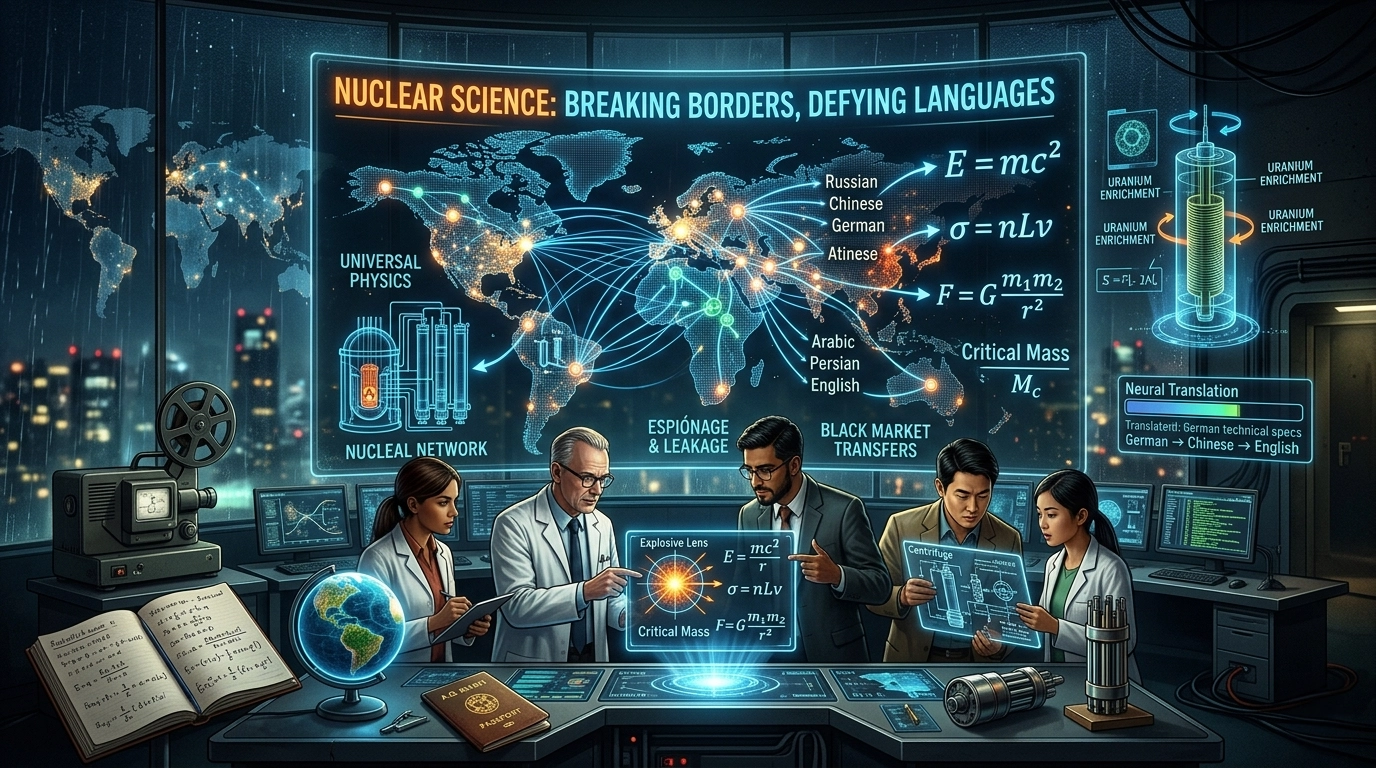
Let’s be real for a second: if you have a secret, you usually hide it behind a lock, a password, or if you’re feeling old-school a language nobody else speaks. But when it comes to the “Big One” (yes, we’re talking nuclear tech), the world found out pretty quickly that science doesn’t give a damn about your dictionary.
You might wonder: How did a scientist in a cold Siberian lab understand a blueprint drawn in a sun-drenched California basement? They didn’t have Google Translate in 1945, right? Well, grab your coffee, because the story of how nuclear knowledge leaked across the globe is a wild mix of high-stakes heist, universal logic, and some very “entrepreneurial” scientists.
1. Math: The Ultimate “Universal Translator”
Imagine you’re looking at a text in ancient Hieroglyphics. You’re lost, right? Now, imagine looking at $E=mc^2$.
Whether you speak Mandarin, Russian, or Arabic, that equation says exactly the same thing. In the world of high-stakes physics, Math is the “Lingua Franca.” * The Logic of Physics: When American scientists calculated the “Critical Mass” for Uranium, they used variables and constants that are universal. A Russian physicist doesn’t need to know English to understand a derivative or an integral on a stolen napkin.
- Visual Blueprints: Have you ever put together IKEA furniture? You don’t read the instructions; you look at the pictures. A nuclear centrifuge or a reactor core has a “physical logic.” The dimensions, the curves, and the materials tell a story that a trained engineer can “read” just by looking at the schematics.
Quick thought: If the universe speaks in math, can we really expect a “secret” written in math to stay hidden for long?
2. The “A.Q. Khan” Effect: The Uber of Nuclear Secrets
If there was a “LinkedIn” for nuclear smuggling, Abdul Qadeer Khan would have been the most endorsed person on the platform.
Khan didn’t just leak secrets; he built a global franchise. He was a polyglot who studied in Europe, mastered the technical jargon of the West, and then “translated” it for the rest of the world.
- The Global Supply Chain: His network was like a dark version of Amazon. He’d get parts from Germany, designs from the Netherlands, and manufacturing help from Malaysia.
- Technical Manuals: He took complex Western engineering and simplified it into “cookbooks” for other nations. He broke the language barrier by becoming the bridge himself.
3. Spies, Microfilms, and “Silent” Pictures
During the Cold War, the KGB wasn’t sending their agents to English Literature classes. They were sending them to take pictures.
Think about Klaus Fuchs, the physicist who infiltrated the Manhattan Project. He didn’t just tell the Soviets “how it felt” to build a bomb; he gave them the raw data. * The Power of the Image: A photograph of a trigger mechanism doesn’t need a caption. In the world of espionage, a picture isn’t just worth a thousand words—it’s worth a thousand years of research.
- The Transfer: Documents were shrunk onto microfilm and smuggled in heels of shoes or hollowed-out coins. The “language” being moved was purely visual and mathematical.
4. Operation Paperclip: Importing the Brains
Sometimes, you don’t steal the book; you kidnap the author. After WWII, the US and the USSR went on a literal “talent raid.” Through Operation Paperclip, the US scooped up German scientists like Wernher von Braun. The Soviets did the exact same thing.
- The Lab Language: When you’re standing over a workbench, pointing at a high-speed turbine, you don’t need perfect grammar. You use hand signals, sketches, and shared technical terms. These scientists “transplanted” the knowledge through direct human interaction, bypassing the need for translated textbooks.
5. Fast Forward to 2026: AI and the Death of Secrets
In our current era, the language barrier is officially a relic of the past.
- AI Translation: Today, if a hacker gets their hands on a Chinese technical server, they don’t need a translator. Modern AI can translate highly technical, jargon-heavy documents in milliseconds with near-perfect accuracy.
- Reverse Engineering: With 3D scanning and advanced metallurgy, if a country gets their hands on even one piece of hardware, they can “deconstruct” the secret. The object itself becomes the teacher.
The Bottom Line
Nuclear technology didn’t spread because countries were good at learning languages. It spread because gravity, fission, and radiation don’t speak English or Russian—they speak Physics. The walls we build—whether they are made of concrete, classification levels, or different alphabets—are surprisingly porous when the “language” being shared is the fundamental code of the universe.
Now, I’ve got a question for you: In a world where AI can translate any secret instantly and 3D printers can replicate complex parts, do you think “national secrets” even exist anymore, or are we just pretending they do? Let me know what you think , Ricky Trash so curious to see your take on this!