
Hey everyone, Ricky Trash here.
Let’s talk about a revolution that isn’t happening in a Silicon Valley basement or a crypto exchange, but in the dirt. We often think of farming as an “old world” profession—manual labor, praying for rain, and guessing when a tomato is “red enough.”
But let’s be real: Launching my blog is someone’s dream, and my dream is to see technology bridge the gap between ancient traditions and futuristic efficiency. Today, we are breaking down Big Data in agriculture and AI Algorithms in agriculture. We’re talking about how we went from “I think it’s time to harvest” to “The algorithm says harvest at 4:15 AM on Tuesday for 99% peak nutrient density.”
Grab your coffee. Let’s get into the data.
The “Data Hunger” of Modern Fields ( Big Data in Agriculture )
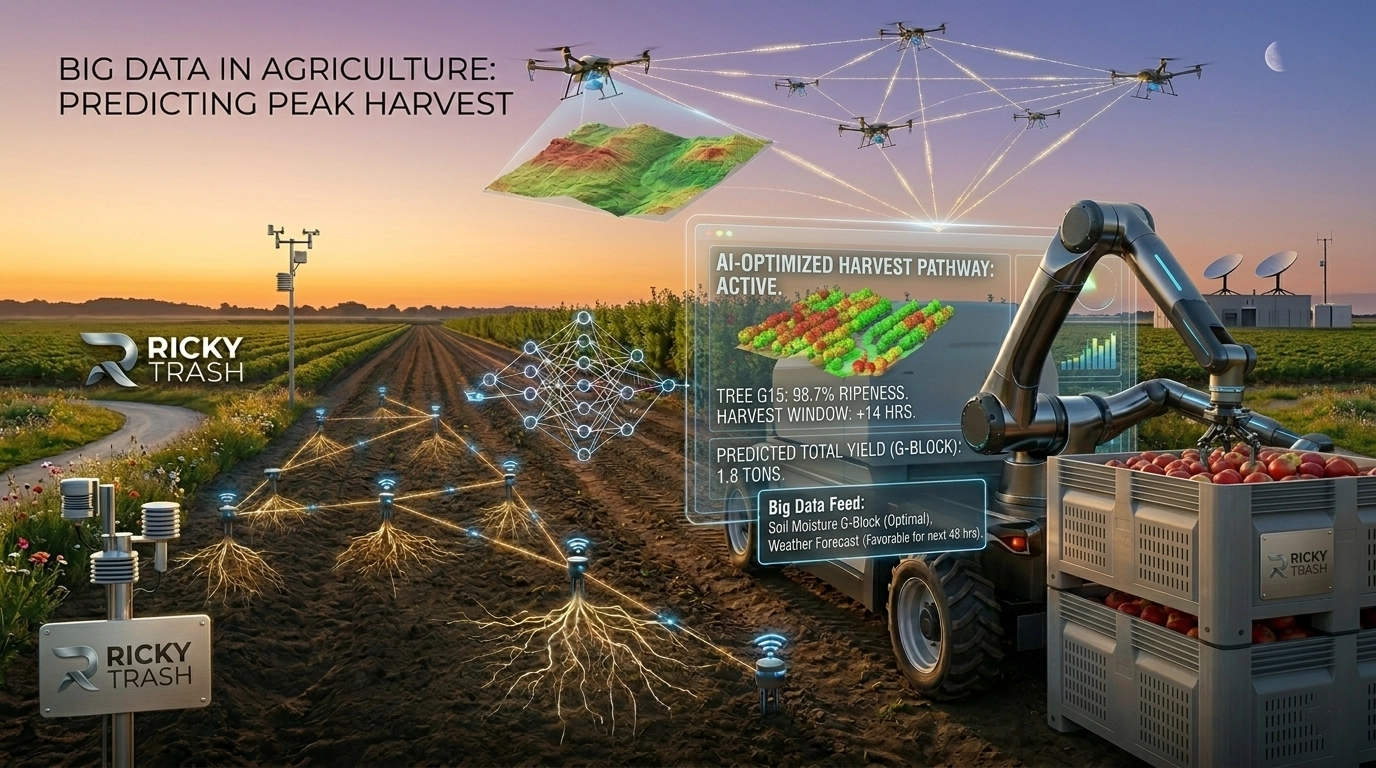
In the past, a farmer knew his land by walking it. Today, a “Smart Farm” generates millions of data points every single day. This is what we call Big Data. But data by itself is just noise. It’s a pile of numbers that means nothing unless you have a “brain” to process it.
That brain is Artificial Intelligence (AI).
When we combine satellite imagery, soil sensors, and weather stations, we create a massive digital ecosystem. For a blog that covers science and technology, this is the ultimate intersection. We aren’t just planting seeds; we are programming life.
The 99% Accuracy Myth or Reality?
You might see headlines claiming “99% accuracy” and think it’s marketing fluff. As someone who analyzes institutional algorithms in trading, I know that 99% is a bold claim. However, in agriculture, this doesn’t mean predicting the future—it means calculating the optimum.
By using Computer Vision, AI can look at the color, shape, and size of a fruit across 1,000 acres simultaneously. It compares these images to a database of millions of other “perfect” harvests. When the AI says “99%,” it’s telling you that the biological markers of the plant align almost perfectly with the peak profit window.
How AI Algorithms Predict the Harvest
Let’s get technical—Ricky Trash style. There are three main pillars to this predictive power:
1. Machine Learning & Historical Patterns
Just like we look at “Order Blocks” in trading to see where the market moved before, AI looks at historical crop cycles. It analyzes decades of weather patterns, soil depletion levels, and yield results.
- The Algorithm: It uses Regression Analysis to determine how one variable (like a 2-degree Celsius spike) affects the ripening speed.
2. The Power of “Computer Vision”
Imagine a drone flying over a field. It’s not just taking a video for YouTube. It’s using Hyper-spectral Imaging. It “sees” light frequencies that the human eye cannot. It can detect chlorophyll levels and water stress before the plant even looks wilted.
- The Result: The AI identifies “hot zones” where the harvest is ready and “cold zones” that need three more days. This is precision.
3. Internet of Things (IoT) Integration
The soil is literally talking. Thousands of sensors buried in the ground measure nitrogen, phosphorus, and potassium (NPK) levels.
- The Connection: These sensors feed into a central hub. If the nitrogen drops, the AI knows the plant growth will slow down, and it adjusts the “Harvest Clock” in real-time.
Why This Matters for the “Ricky Trash” Community
Why am I writing this for you? Because whether you are interested in Finance, Luxury, Technology, or Science, Big Data in Agriculture affects your wallet and your world.
- Economic Stability: Food waste is a trillion-dollar problem. If we can predict harvest perfectly, we reduce waste, which stabilizes food prices. That’s macroeconomics 101.
- Investment Opportunities: The “AgTech” (Agricultural Technology) sector is exploding. For those looking for the next big “SMC” style move in the stock market, keep an eye on companies integrating AI with sustainable farming.
- Sustainability: We are facing a global population crisis. We can’t just “plant more.” We have to “plant smarter.”
The Dark Side: Is There a Catch?
As a blogger who values transparency, I have to ask: What’s the downside?
- Data Monopoly: Just like big banks control the flow of money, big tech companies now control the data of the soil. If a farmer doesn’t own his data, does he really own his farm?
- The Cost of Entry: Setting up a “99% accuracy” system isn’t cheap. It requires high-speed internet (Starlink, anyone?), expensive sensors, and the tech-savviness to run it.
Looking Forward: May 2026 and Beyond
As I prepare to launch my Mystery Persona next month, I’ve been thinking a lot about the “unseen forces” that run our world. Whether it’s an algorithm deciding your next trade or an AI deciding when to pick an apple, the world is becoming a series of calculated probabilities.
The “Smart Farm” isn’t just about food; it’s a blueprint for how we will manage everything in the future—from our energy grids to our personal health.
Join the Conversation!
I want to hear from you. You guys are the heartbeat of the Ricky Trash blog.
- Do you think we are relying too much on AI? * Would you trust a “robot-grown” apple over one grown by a traditional farmer?
- If you had the capital, would you invest in a Smart Farm or stick to digital assets?
Drop a comment below. I read every single one, and your feedback helps me decide what science topics to dive into next. Remember, we are building this high-authority platform together.
Launching my blog is someone’s dream. Let’s make it a reality that changes how we think about the world.
Stay smart, stay hungry.
Key Takeaways for the “Smart” Reader:
| Technology | Function | Benefit |
| Big Data | Collects millions of environmental points. | Eliminates “guessing.” |
| AI Algorithms | Processes data to find the “peak.” | Increases profit margins. |
| Drones/Satellites | Monitors plant health from above. | Early disease detection. |
| IoT Sensors | Real-time soil chemistry analysis. | 90% water savings. |