
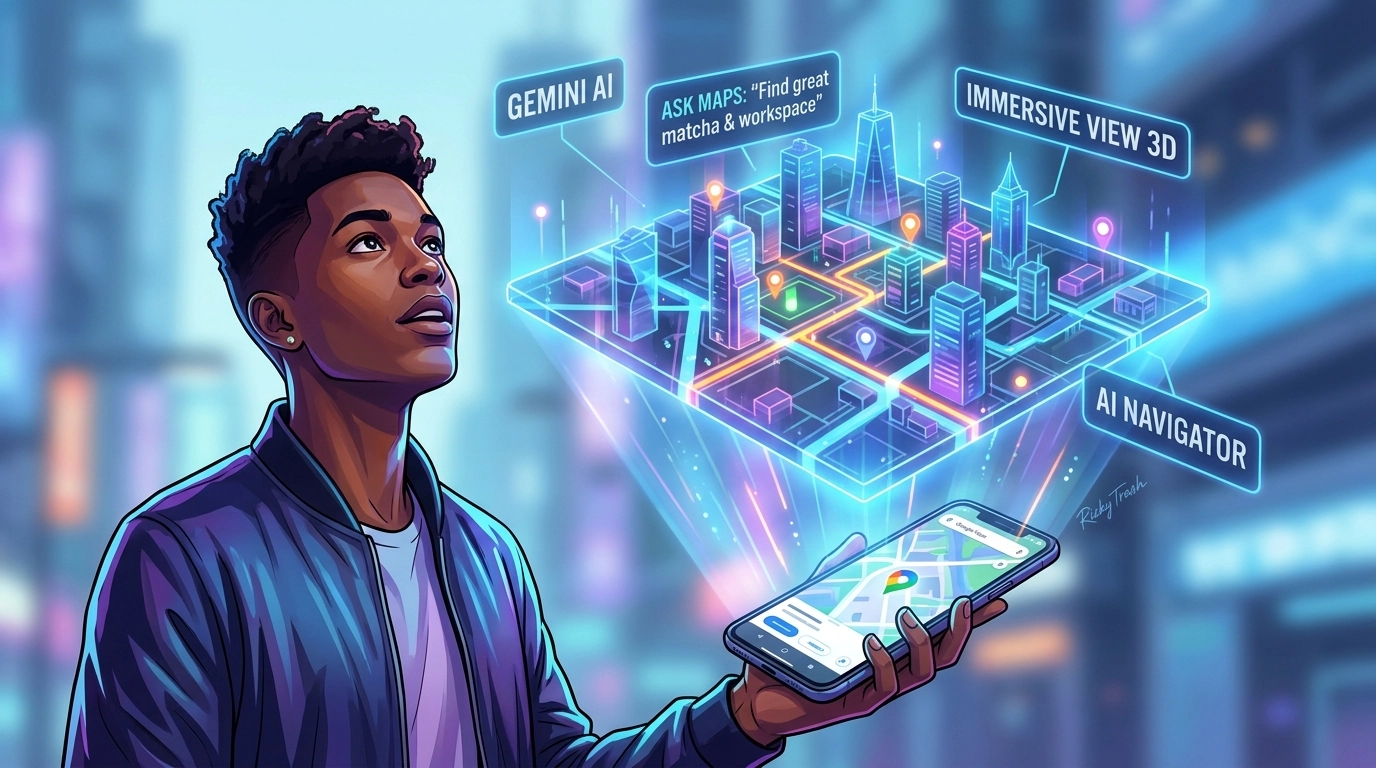
Listen up, because the world just got a whole lot smaller and a lot more intelligent.
I remember the “Dark Ages” of navigation. I’m talking about that bulky, beige plastic box suction-cupped to my windshield like a confused parasite. It would scream “RECALCULATING!” with the judgmental tone of a disappointed parent every time I took a shortcut through a Chick-fil-A parking lot. Fast forward to 2026, and that technology looks like a stone tool compared to the absolute sorcery happening inside AI Google Maps right now.
Google isn’t just “updating an app.” They are fundamentally rewiring how we, as biological units, interact with the physical planet. By injecting the Gemini AI model directly into the grid, they’ve turned a simple map into a mentor—or perhaps a very smart, slightly stalkerish best friend who knows exactly where the best matcha is before you even realize you’re thirsty.
I’ve spent the last few weeks living inside this “Digital Twin” of our world. If you’re looking for the raw, human take on why this is the biggest shift in travel technology since we stopped using paper maps as emergency blankets, you’re in the right place. Grab a coffee, settle in, and let’s dive into the matrix.
1. The “Ask Maps” Phenomenon: Talking to Your Streets
Let’s talk about the “Paradox of Choice.” The old way of using maps was exhausting. You’d search for “dinner,” get 100 identical red pins, and then waste twenty minutes of your life scrolling through blurry photos of lukewarm lasagna just to find a place that didn’t scream “tourist trap.”
The Upgrade: AI Google Maps as Your Local Fixer
With the new AI Google Maps integration, the search bar is effectively dead. It’s no longer a query; it’s a conversation. I stopped filtering by “star ratings” and started asking complex, multi-layered, “Ricky-style” questions that would make a traditional database explode:
“Hey Google, I need a spot to work for four hours that has decent natural lighting, won’t kick me out for nursing a single drink, has fast Wi-Fi, and serves a killer matcha latte with oat milk.”
Gemini doesn’t just look for the keyword “matcha” in a metadata field. It’s smarter than that. It scans millions of user reviews, looking for semantic clues like “laptop-friendly,” “plenty of outlets,” or “chill staff.” It understands the unspoken rules and the “vibe” of a location. For a content creator or a digital nomad, this isn’t just a feature—it’s a literal survival tool.
2. Immersive View: Killing “Social Arrival Anxiety” Once and For All
We’ve all felt it. That localized spike in heart rate when you’re driving to a new spot and realize you have no idea where the parking garage entrance is, or if the building entrance is hidden in some dark alleyway. I call it “Social Arrival Anxiety,” and it’s a vibe-killer.
The Technical Magic of NeRF
Google is using something called Neural Radiance Fields (NeRF). This is high-level math that turns billions of flat, 2D images into a fully realized 3D world. But as a user? It just feels like teleportation.
Using the new “Time Slider,” I scouted a rooftop bar in London while sitting in my sweatpants in Brooklyn. I could see exactly where the shadows would fall and where the sun would set at 7:30 PM this coming Friday.
- Check the Entrance: I saw exactly which side street had the valet.
- Peek Inside: I “walked” through the restaurant to see if the tables were too cramped for a private meeting.
- Weather Simulation: I saw what the street looked like under rain vs. sun.
This “Digital Twin” of the world is the ultimate weapon for people who hate surprises. It’s the closest we’ve come to a video game “mini-map” for real life.
3. The 3D Navigation Revolution: No 14th-Gen Vision Required
Traditional navigation is 2D. But the world—especially in vertical jungles like Tokyo, New York, or Dubai—is very much 3D. A flat blue line on a screen is a recipe for missing an exit that’s actually a ramp hidden behind a skyscraper of AI Google maps .
The Real-Time Shift
The latest AI Google Maps update utilizes massive processing power to render transparent 3D buildings and lane guidance in real-time.
- Visual Matching: When the app tells you to turn, you see the actual architecture of the building you’re turning next to. It matches your windshield view perfectly.
- Reduced Cognitive Load: You spend less brainpower translating a flat map to the real world and more brainpower actually watching the road.
- Human Directions: Instead of “Turn right in 300 feet,” the AI says, “Turn right just after the yellow building with the mural.” It sounds like a local friend riding shotgun.
4. Comparing the Eras: The Evolution of Navigation
To truly appreciate how far we’ve come with AI Google Maps, check out this breakdown of the tech evolution:
| Feature | The GPS Era (2000s) | The Smartphone Era (2010s) | The AI Google Maps Era (2026) |
| Hardware | Bulky plastic boxes | Smartphones | AI-Integrated Wearables/Phones |
| Interface | Low-res 2D lines | 2D + Satellite views | 3D Immersive “Digital Twin” |
| Search | Specific Addresses only | Keyword-based (e.g., “Pizza”) | Conversational (e.g., “Quiet vibes”) |
| Context | Zero context | Basic traffic data | Deep Vibe & Predictive Analysis |
| Voice | Robotic & Angry | Siri/Google Assistant | Gemini (Natural & Contextual) |
5. Why This is a Goldmine for Bloggers and Local SEOs
If you run a local business or a travel blog, wake up! The game has changed. We are officially moving from Search Engine Optimization (SEO) to AI-Response Optimization (ARO).
- The “Vibe” Economy: Gemini prioritizes businesses that have high-quality, 3D-friendly visual data. If your business doesn’t have updated “Street View” style interiors or high-res photos, the AI can’t “see” you well enough to recommend you in a conversation.
- Context is King: The AI favors businesses mentioned in specific, niche contexts within reviews. If your reviews say “perfect for a rainy day read,” you will win the “Ask Maps” query for “indoor cozy spots,” even if those words aren’t on your official website.
- Visual Data: Start taking 360-degree videos of your storefront. Google’s AI loves “spatial” data.
6. The “Creepy” Factor: Privacy vs. Convenience
Let’s be real for a second—it’s a little wild. For Google to tell me, “Hey Ricky, you usually like spicy food on Tuesdays, and there’s a highly-rated Thai place on your route that’s about to close in 20 minutes,” it has to know my soul.
We are entering an era where our maps know our habits better than our partners do. Is the convenience worth the trade-off?
- The Pro: You never have a bad meal or get lost again.
- The Con: You are essentially a data point in a global simulation.
For me, when I’m hungry in a foreign city and I’m looking for that one “hidden” speakeasy, the answer is usually “Take my data, just feed me.” But it’s a conversation we need to keep having as AI becomes our permanent co-pilot.
7. The Future: Wearables and Augmented Reality
This AI Google Maps update is clearly the “beta test” for the AR glasses revolution. Google is teaching its AI how to describe the world so that one day, it can whisper directions directly into our ears as we walk, pointing out landmarks, historical facts, and even “Review Bubbles” floating over restaurants in real-time.
We aren’t just looking at maps anymore; we are living inside them.
Final Verdict: The “Blue Dot” is Dead
Google Maps is no longer a map. It’s a Life Assistant. It’s the difference between having a piece of paper and having a local expert standing next to you who has memorized every brick in the city. As we move further into 2026, the era of the “static map” is over. Long live the AI Navigator.
What do you think? Is the new AI integration a dream come true for travelers, or is it getting a little too “Big Brother” for your taste? Have you tried the “Ask Maps” feature yet? Drop a comment below and let’s talk about it!