
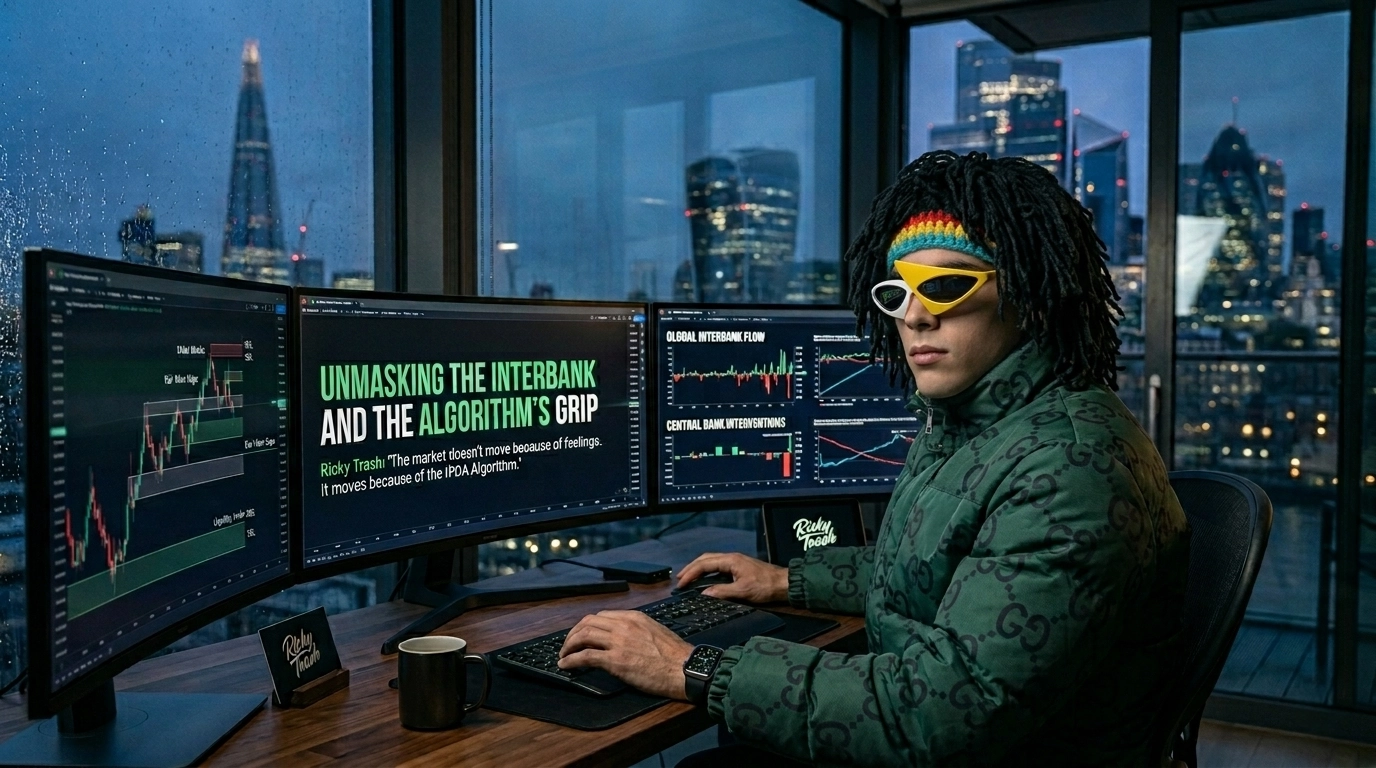
What’s up, everyone? Ricky Trash here.
If you’ve been following the journey, you know we don’t do “retail logic” on this blog. We don’t care about your “Double Bottoms” or your “RSI Oversold” signals. Why? Because those are the breadcrumbs left behind by the wolves to lead the sheep to the slaughter. If you want to stop being the liquidity and start engineering it, you have to understand where the real money lives.
We are talking about the Interbank Market Secret .
Grab a coffee—or something stronger—because we’re going deep. This isn’t a surface-level “Forex 101” blog post. This is a deep dive into the nervous system of global finance and how the IPDA (Interbank Price Delivery Algorithm) actually breathes.
1. What is the Interbank Market, Really?
Think of the Interbank Market as the “private club” of world finance. It’s a decentralized, over-the-counter (OTC) network where the world’s largest banks trade currencies and other financial assets directly with each other.
There is no central building. There is no “Exchange Floor” in the sky. It is a massive, digital web of credit lines and high-speed connections.
The Players:
- The Tier 1 Giants: We’re talking JP Morgan, ICBC, Citibank, Deutsche Bank, and HSBC. These guys handle over 50% of the world’s daily volume.
- Central Banks: The Fed, the ECB, the BOJ. They don’t trade for profit; they trade for policy.
- The Inter-Dealer Brokers: The middlemen who facilitate the massive “whales” shifting billions without moving the market too violently (until they want to).
Why it matters to you: When you open your trading app (the one with the pretty colors and the “Buy” button), you aren’t in the Interbank Market. You are playing in a “retail bucket shop” that gets its prices from the Interbank. You are seeing the ripples; they are the ocean.
2. The Myth of “Supply and Demand”
I hear you guys in the comments all the time: “Ricky, price went up because there were more buyers than sellers!”
Wrong. In the Interbank world, there is always a buyer for every seller. The Interbank Market is about Liquidity and Efficiency. The market doesn’t move because of “feelings.” It moves because the Interbank Price Delivery Algorithm (IPDA) is programmed to seek out pools of liquidity to neutralize orders.
The Interbank market exists to facilitate international trade and capital flow. If Apple needs to buy components from Japan, they need Yen. They don’t look at a “Head and Shoulders” pattern. They need 10 billion Yen now. The Interbank market provides that.
3. IPDA: The Algorithm Behind the Curtain
This is where the Ricky Trash philosophy kicks in. Most traders think price is random. I’m telling you, it’s a script.
The IPDA is a digital nervous system used by the central banks and Tier 1 institutions to deliver price at specific times and levels. It works on quarterly, monthly, weekly, and daily cycles.
How the Algorithm “Thinks”:
- Consolidation: The market waits. It builds up “orders” on both sides. Retail traders see a “range” and get excited.
- Expansion: The algorithm suddenly shifts price. This isn’t “news” (though news is used as an excuse). This is price moving toward a specific “Fair Value” or “Liquidity Pool.”
- Retracement: Price comes back to pick up the institutional orders that weren’t filled during the expansion.
- Reversal: Price hits a major Interbank level and heads the other way.
If you aren’t tracking these four phases, you’re just gambling. Are you still using Trendlines? Stop it. The Interbank market uses trendlines as “Liquidity Engineered” traps.
4. Liquidity: The Only Reason Price Moves
Let’s get interactive for a second. Look at your last losing trade. Where was your Stop Loss?
I can bet it was tucked neatly under a “Recent Low” or above a “Recent High.” In the Interbank world, your Stop Loss is a Sell Stop or a Buy Stop. To a Tier 1 bank, your Stop Loss isn’t a safety net; it’s fuel.
The Two Types of Liquidity:
- BSL (Buy Side Liquidity): Located above old highs. This is where the “Breakout Buyers” enter and where the “Sellers” have their stops.
- SSL (Sell Side Liquidity): Located below old lows. This is where the “Panic Sellers” enter and where the “Longs” have their stops.
The Interbank Algorithm must run these levels to find enough volume to fill their massive positions. They can’t just click “Market Buy” for $500 million. They need to trigger a wave of Sell Stops (which are sell orders) so they can buy them.
This is the “Stop Hunt.” It’s not a conspiracy; it’s a mechanical necessity of the Interbank Market.
5. Time and Price: The Interbank Secret Sauce
If you want to trade like the Interbank players, you have to throw your 24-hour clock away. The Interbank market operates on specific Kill Zones.
- The Asian Session: Usually a consolidation phase where liquidity is engineered.
- The London Open: The “Judas Swing.” This is where the Interbank market often creates the high or low of the day by fake-pumping price to grab liquidity before the real move.
- The New York Open: The “Reversal or Expansion” phase. This is where the big “Smart Money” volume from the US banks hits the tape.
Are you trading at 3:00 PM on a Friday? Why? The Interbank desks are closing. The volume is gone. You’re just trading against your broker’s spread.
6. The Relationship Between Interbank and Your Trading
You might be thinking, “Ricky, I only have $1,000 in my account. I’m not a bank.” True. But you can piggyback.
When you understand Interbank delivery, you stop looking for “Support.” Instead, you look for Order Blocks. An Order Block is a specific candle where the Interbank players placed their massive orders. When price returns to that level, the Algorithm is programmed to react.
Why retail traders fail: They try to predict. Interbank traders (and those of us who follow them) react to the footprints.
We look for:
- Liquidity Sweeps: Did price just break a major high and then immediately crash? That’s an Interbank “Grab.”
- Market Structure Shifts: When the Interbank trend changes, it doesn’t whisper. It screams through massive, impulsive moves that leave “Fair Value Gaps” (FVG) behind.
- The Premium vs. Discount Array: The Interbank market never buys at a high price. They wait for a “Discount.” If you are buying after a huge green candle, you are buying at a Premium. You are the “exit liquidity” for the banks.
7. Global Geopolitics and the Interbank Market Secret Web
Since we talk a lot about the “brains” of nations on this blog—like the engineering of Italy or the economic logic of the Netherlands—we have to realize that the Interbank market is the tool of Soft Power.
When a country’s Central Bank intervenes in the Interbank market, they are defending their sovereignty. When the Bank of Japan (BoJ) steps in to buy Yen, they are fighting the global Interbank flow. As a trader, if you aren’t watching the yield spreads (the difference between bond interests), you’re flying blind.
The Interbank market is the ultimate truth-teller. Politicians can lie, but the Price Delivery Algorithm doesn’t.
8. Mastering the Interbank Mindset (The Ricky Trash Way)
To trade in harmony with the Interbank Market, you have to undergo a total “Brain Reset.”
- Stop looking for “Patterns”: Start looking for “Objectives.” Where does the Algorithm want to go next? Is there an unfilled gap? Is there an old high that hasn’t been touched in weeks?
- Accept the Manipulation: Stop getting mad when your stop gets hit and price goes in your direction. That was the Interbank market doing its job. Your job is to wait for the “Stop Hunt” to happen before you enter.
- Focus on High CPC (Context, Price, Correlation): Just like I teach you in SEO and blogging—focus on where the value is. In trading, the value is in the Higher Timeframe (HTF). The Interbank players don’t care about the 1-minute chart. They care about the Daily and Weekly levels.
9. Conclusion: Don’t Be the Trash, Be the Collector
The Interbank market is the most sophisticated system ever created by man. It is a mathematical, algorithmic masterpiece designed to keep the global economy moving while efficiently harvesting the capital of those who don’t understand the rules.
You have two choices:
- Continue trading like a “Retailer,” using 1970s indicators and wondering why you’re a “breakeven” trader at best.
- Start studying Institutional Order Flow. Learn to see the Liquidity. Respect the Time Macro.
I’m building the Ricky Trash brand on transparency and high-level engineering—whether it’s my blog, my store, or my trading strategy. We don’t settle for “average.” We look for the “Zero Drawdown” entry because we understand that once the Interbank Algorithm starts its expansion, it doesn’t look back.
What do you think? Are you still trapped in the “Support and Resistance” matrix, or are you ready to see the code in the machine? Leave a comment below. I want to see who’s actually putting in the work to understand the IPDA.
Until next time, stay sharp, stay skeptical, and keep engineering your own success.
— Ricky Trash
Quick Interbank Summary Table for the Visual Learners:
| Feature | Retail Perspective | Interbank (Smart Money) Perspective |
| Price Movement | Random / News Driven | Algorithmic (IPDA) |
| Support / Resistance | Places to Buy/Sell | Pools of Liquidity (Targets to Hit) |
| Indicators | RSI, MACD, EMA | Time Macros, Order Blocks, FVGs |
| The “Goal” | To catch a “Trend” | To neutralize liquidity and find Fair Value |
| Stop Loss | Protection | The “Fuel” for the next move |
Disclaimer: This article is for educational and branding purposes. Trading involves significant risk. I am a content creator, and a strategist—not your financial advisor. Use your brain.