
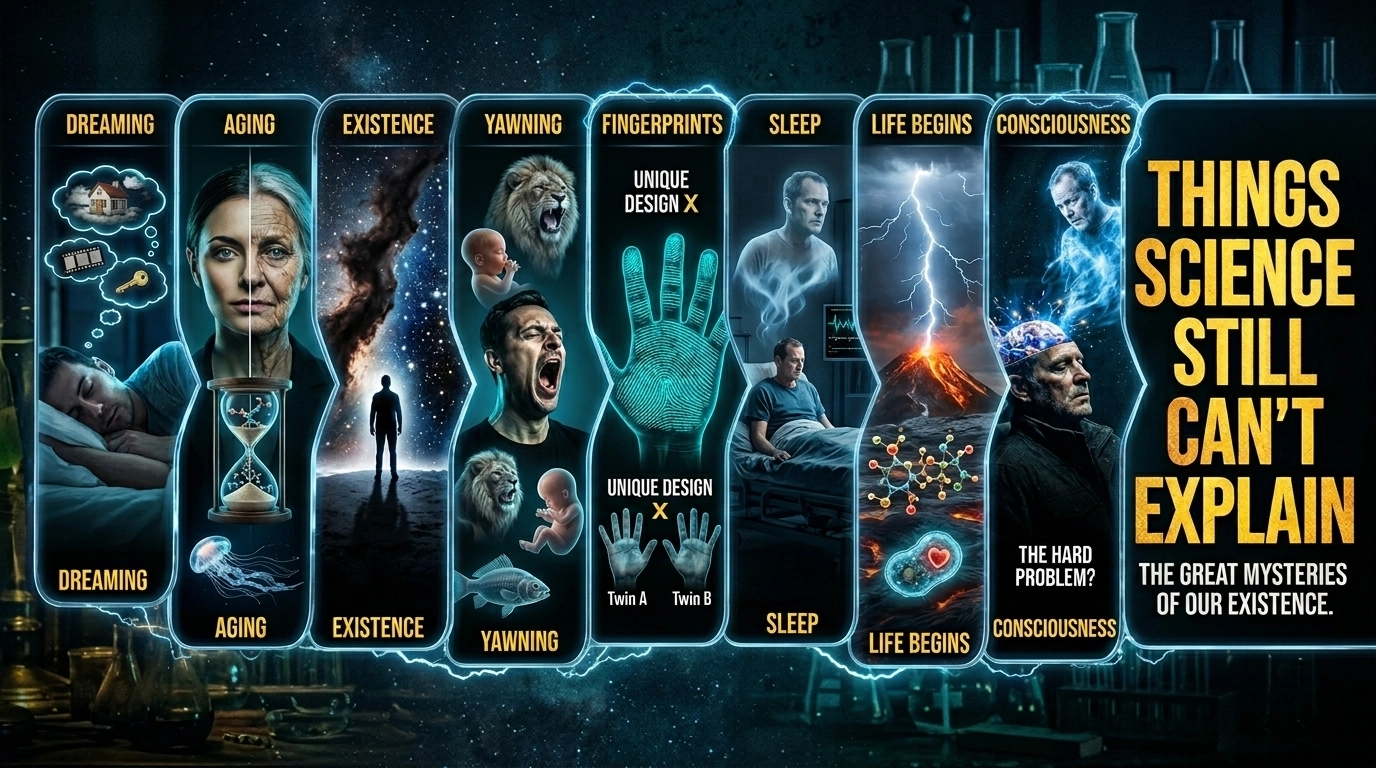
Welcome back to the blog. If you’re here, you’re likely tired of the surface-level “hustle” content and looking for something that actually challenges your perspective on reality. Today, we’re stepping away from the charts and the code to look at the massive gaps in human knowledge it’s the Great Mysteries of Our Existence.
Despite our high-speed internet, advanced AI, and space exploration, we are still surrounded by fundamental mysteries. In this deep dive, we’re going to explore nine enigmas that continue to baffle the greatest minds in physics, biology, and philosophy.
Buckle up. It’s time to talk about what we don’t know.
1. Why Do We Dream? (The Nightly Cinema)
We spend roughly six entire years of our lives in a dream state. Every night, your brain creates high-definition, immersive, and often bizarre simulations while your body stays paralyzed in bed. Yet, scientists still have no definitive answer as to why.
There are several competing theories:
- The Memory Consolidation Theory: This suggests dreaming is the brain’s way of sorting through the day’s data—deciding what to keep and what to trash.
- The Threat Simulation Theory: Some evolutionary psychologists believe dreams are a “training ground” for survival, allowing us to practice responding to dangerous situations.
- The Emotional Regulation Theory: Dreams might be a way to process intense feelings in a safe, neurochemically calm environment.
Despite these guesses, every theory has failed to explain the full scope of the dreaming experience. Is it just biological “noise,” or is there a deeper purpose we haven’t unlocked yet?
2. Why Do We Age? (The Immortal Paradox)
In a world where some species of jellyfish are biologically immortal and lobsters show no signs of typical “aging,” why do humans wither and die? On the surface, it seems like simple “wear and tear,” but the biological reality is far more complex.
We understand the mechanisms—like telomere shortening and oxidative stress—but we don’t truly understand the why. If our bodies have the machinery to repair cells, why does that machinery eventually just… give up? Some scientists argue that aging is a “programmed” part of life to ensure room for new generations, while others believe it’s a catastrophic failure of complex systems. Until we solve this, we are all living on a ticking clock that we don’t fully understand.
3. Why Does Anything Exist? (The Ultimate Question Of Existence)
This is the big one. Physics is incredible at describing what exists and how it behaves. We have equations for gravity, electromagnetism, and quantum mechanics. But physics cannot explain why there is something rather than nothing.
According to our current understanding of the Big Bang, equal amounts of matter and antimatter should have been created, which would have annihilated each other instantly, leaving an empty universe. But here we are. Why did matter “win”? Why are the laws of physics fine-tuned so precisely that life is possible? It’s a mystery that bridges the gap between science and pure philosophy.
4. Why Do We Yawn? (The Contagious Reflex)
You’re probably feeling the urge to yawn just reading this. It’s a reflex we share with lions, snakes, fish, and even fetuses in the womb. It’s one of the most basic biological functions, yet it remains unexplained.
The old theory that we yawn to “get more oxygen” has been largely debunked. Newer theories suggest it might be a way to “cool the brain” or a social cue to keep a group alert. However, none of these explain why it’s so incredibly contagious across species. Why does a human yawning make a dog yawn? We’re still in the dark.
5. Why Do Humans Have Fingerprints?
Every human on earth has a completely unique fingerprint. Even identical twins, who share the exact same DNA, have different patterns on their fingertips. While we’ve used them for identification for over a century, we still don’t know their primary evolutionary purpose.
Common myths suggest they are for grip enhancement, touch sensitivity, or blister protection, but scientific testing has shown that flat skin can actually provide more friction in certain conditions. We have these intricate, unique markers on our bodies, and we are still searching for the “why” behind the design.
6. Why Do We Need Sleep? (The 30-Year Mystery)
We spend one-third of our lives unconscious. If you live to be 90, you’ve spent 30 years asleep. Sleep deprivation kills faster than starvation, meaning sleep is more vital than food.
We know that sleep “recharges” us, but from a purely evolutionary standpoint, sleep is a disaster. It leaves us vulnerable to predators for hours every single day. If science could find a way to perform the restorative functions of sleep while we stayed awake, the world would change overnight. But we can’t, because we still don’t know exactly what “unconsciousness” is doing for our survival.
7. How Did Life Begin? (The Spark)
We can track the evolution of life back billions of years, but the very first step abiogenesis remains a mystery. How did “dead” chemicals suddenly arrange themselves into a living, self-replicating cell?
There is a massive gap between complex chemistry and simple biology that science has yet to bridge in a laboratory. Whether it happened in deep-sea vents, via lightning strikes in a “primordial soup,” or arrived from space via panspermia, the “spark” of life is the greatest cold case in history.
8. What Is Consciousness? (The Hard Problem)
How does three pounds of “meat” (your brain) create the subjective feeling of being you? This is what philosophers and neuroscientists call “The Hard Problem.”
We can map which parts of the brain light up when you’re happy or sad, but we cannot explain how physical matter produces a non-physical experience like the “redness” of a rose or the “feeling” of a memory. Is consciousness an accidental byproduct of evolution, or is it a fundamental property of the universe itself? No one has solved it.
Why This Matters for You
As a digital entrepreneur, I’m constantly looking at data and logic. But looking at these mysteries reminds me of one thing: We don’t have all the answers, and that’s where the opportunity lies.
In business, trading, and life, the people who succeed are the ones comfortable operating in the “unknown.” If science—with all its billions in funding—can’t explain why you yawn or dream, don’t feel bad if you haven’t figured out your 10-year plan yet.
Let’s talk in the comments: Which of these nine mysteries fascinates you the most? Do you think we’ll solve the “Hard Problem” of consciousness in our lifetime, or are some things meant to stay hidden?
Drop your thoughts below. Let’s get into it.