
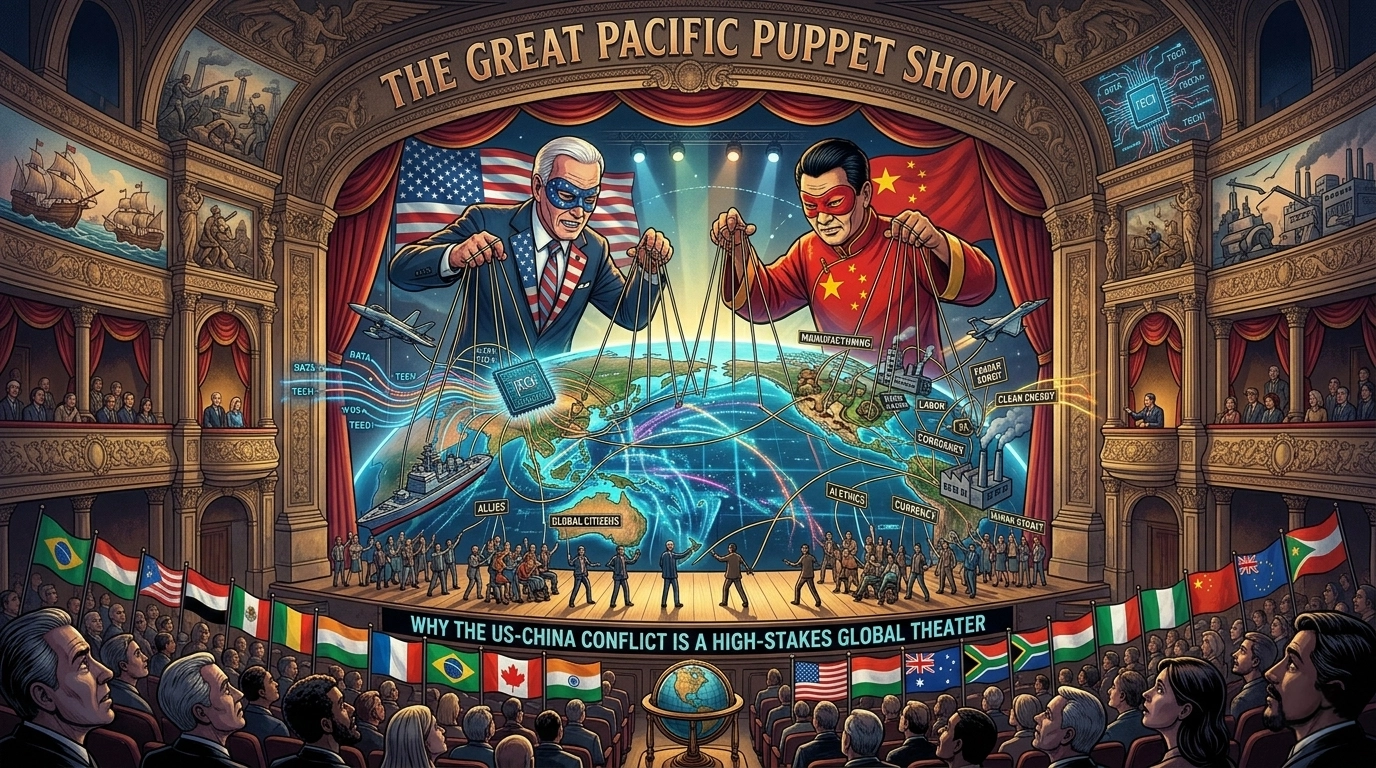
Turn on the news, and the narrative is always the same: we are on the brink of World War III. Trade wars, spy balloons, South China Sea skirmishes, and the “looming threat” of TikTok. It makes for great ratings, doesn’t it? But if you pull back the curtain and look at the actual plumbing of the global economy, a much weirder, much more “staged” reality starts to emergeUS-China.
Is it a cold war, or is it a choreographed dance? While politicians scream about national security, the digital and economic floodgates remain wide open in ways that don’t just suggest cooperation—they suggest a deep-seated partnership that neither side actually wants to break.
Let’s dive into why the “Great Rivalry” might just be the most expensive theater production in human history.
1. The Digital Trojan Horse (That We Invited In)
The most common argument for the US-China rivalry is “technological sovereignty.” Washington claims Chinese apps are data-harvesting tools for the CCP. If that were the existential threat they claim, wouldn’t the response be swift and total?
Instead, we see a fascinating contradiction. While China maintains its “Great Firewall,” banning Facebook, YouTube, and Google for over a decade to protect its internal market and social narrative, the US has done the opposite. The Google Play Store and Apple App Store have effectively rolled out the red carpet for Chinese giants.
- TikTok: It isn’t just a video app; it’s a global attention vacuum.
- Temu & Shein: They aren’t just shops; they are direct-to-consumer pipelines that bypass traditional retail.
- Alibaba/AliExpress: The backbone of global dropshipping.
If the US were truly in a “war” with China, why allow these platforms to colonize the American attention span and wallet? The answer is simple: Economic Symbiosis. These platforms provide cheap goods that keep American inflation from spiraling and provide a massive data-driven advertising ecosystem that benefits Western tech giants through competition and market liquidity.
2. Google vs. TikTok: The Competitive Illusion
You’ll often hear that TikTok is “killing” Google’s ad business. But look closer. Google, the ultimate gatekeeper of information, continues to allow TikTok to thrive within its ecosystem (Android and Search).
Why would a monopoly like Google let a competitor eat its lunch? Because TikTok’s presence forces a massive shift in the advertising market that keeps the money moving. When TikTok thrives, Google’s “YouTube Shorts” gets more investment. When Temu spends billions on Google Ads to gain market share, Google wins. The “rivalry” is actually a massive stimulus package for the digital ad industry.
It’s not a fight to the death; it’s a fight for who gets the biggest slice of a growing pie.
Comparative Analysis: Perception vs. Reality
| Feature | The “Political Theater” Narrative | The Economic Reality |
| App Access | “TikTok is a threat to national security and must be banned.” | TikTok remains available; Temu is the #1 downloaded app in the US. |
| Market Access | China bans US Big Tech to “protect” its citizens. | US Tech giants (Apple, Tesla) rely on China for 20-30% of their revenue. |
| Trade Policy | Heavy tariffs and “decoupling” rhetoric. | US-China trade reached record highs recently; supply chains are shifting, not breaking. |
| The “Goal” | Total victory and dominance. | Maintaining a “Managed Friction” that justifies military spending and tech subsidies. |
3. The “Managed Friction” Model
Think about the military-industrial complex for a second. Without a “Big Bad Wolf,” how do you justify trillion-dollar defense budgets? Without the “China Threat,” how does the US pass the CHIPS Act to subsidize its own tech industry with billions of taxpayer dollars?
On the flip side, the Chinese government uses the “US Imperialism” narrative to maintain internal discipline and justify its grip on the tech sector.
Both sides need the conflict to be loud but controlled. If it were a real war, the iPhones in our pockets would stop working tomorrow, and the American consumer economy would collapse in a week. Neither side wants that. They want the spectacle of a fight because the spectacle is profitable.
4. The Global Market Liquidity Factor
The most glaring evidence of this “partnership” is the sheer volume of Chinese products flooding the world via US-controlled platforms. By allowing AliBaba and Temu to use the infrastructure of the Western internet, the US is essentially endorsing China as the “Global Factory” while pretending to be upset about it.
It’s a “Good Cop, Bad Cop” routine on a global scale. The “Bad Cop” (Politicians) threatens sanctions, while the “Good Cop” (Big Tech/Corporations) signs the checks and updates the apps.
The Final Takeaway
We live in an era of Co-dependent Competition. The headlines are designed to keep you distracted, patriotic, or fearful. But while the politicians are arguing on stage, the back-end developers in Silicon Valley and Shenzhen are making sure the APIs still talk to each other. The money is too green, and the supply chains are too deep for this to be anything other than a scripted drama.
Don’t watch what they say. Watch what they allow. And what they allow is a world where China manufactures the world, and America provides the platform to sell it.