
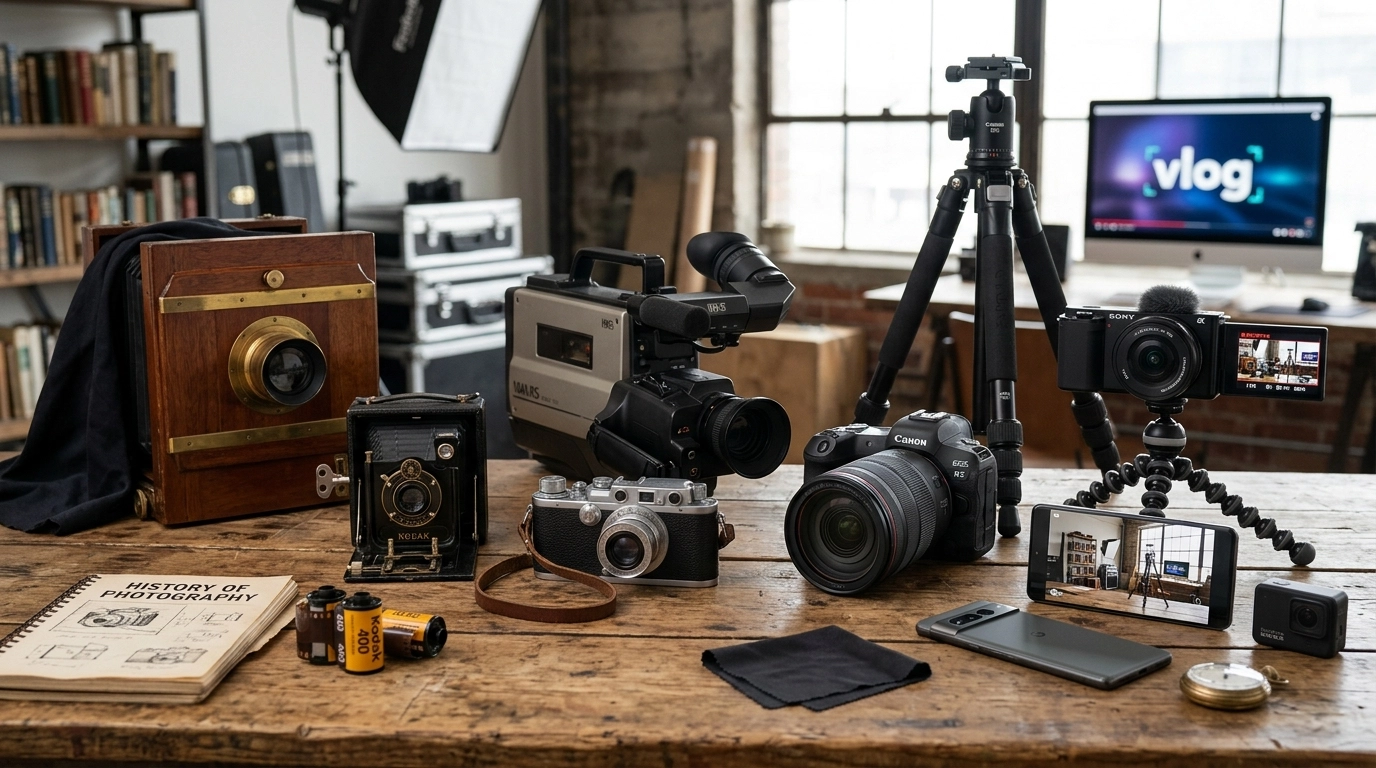
Yo, what is up, guys Ricky Trash Here! Welcome back to the blog. Today, we are going on a wild journey through time. Have you ever looked at your smartphone and wondered how that tiny lens manages to capture your lunch in 4K? It feels like magic, right? But the evolution of the camera didn’t happen overnight. It took centuries of geniuses, accidental discoveries, and some seriously massive equipment to get where we are today.
Grab your coffee, settle in, and let’s get into the nitty-gritty of how humanity learned to freeze time.
The Spark of an Idea: The Camera Obscura
Believe it or not, the evolution of the camera actually starts in a dark room. Long before we had film or sensors, we had the Camera Obscura (Latin for “dark chamber”).
The concept is simple: if you have a totally dark room with a tiny hole in one wall, light from outside passes through that hole and projects an upside-down image of the outside world onto the opposite wall.
- Who thought of it first? Most historians point to the Chinese philosopher Mozi in the 5th century BCE.
- The Science Guy: Later, the Arab scholar Ibn al-Haytham (Alhazen) really cracked the code in the 11th century. He explained exactly how light travels in straight lines, giving us the mathematical foundation for optics.
Imagine standing in a room-sized camera just to see a blurry image of a tree. Talk about a “big” start, right?
From Rooms to Boxes: The 1800s Revolution
For centuries, the Camera Obscura was just a tool for artists to trace landscapes. But people were getting tired of drawing. They wanted the light to do the work. They wanted a permanent image.
1. Joseph Nicéphore Niépce: The First “Photo”
In 1826, a French inventor named Niépce finally did it. He used a portable camera obscura and a bitumen-coated plate. He left the camera sitting in his window for eight hours.
- The Result: A grainy, blurry view of his courtyard.
- The Catch: If you moved, you disappeared! This was a pivotal moment in the evolution of the camera, proving that we could actually “trap” light.
2. Louis Daguerre: The Daguerreotype
Niépce’s partner, Louis Daguerre, took things to the next level in 1839. He figured out that using silver-plated copper and chemicals could reduce the exposure time to just a few minutes. This became the first commercially successful photographic process. But there was no “delete” button, and you certainly couldn’t fit a Daguerreotype in your skinny jeans.
Making it Portable: The Kodak Moment
By the late 1800s, photography was still a messy, chemical-heavy hobby for the rich and the “mad scientists.” That changed when George Eastman entered the chat.
In 1888, Eastman invited the world to “press the button, we do the rest.” He invented flexible roll film and the first Kodak camera. This was a game-changer in the evolution of the camera because you didn’t need to be a chemist to take a picture. You bought the camera, took 100 shots, and mailed the whole thing back to the factory for processing.
Question for you guys: If you only had 100 shots for the entire year, what would you photograph? Let me know in the comments!
The Shrinking Act: Leica and the 35mm Boom
As we moved into the 20th century, cameras started hitting the gym and leaning out. In 1913, Oskar Barnack at Leica had a brilliant idea. He wanted a camera that could fit in a jacket pocket but still take high-quality images.
He repurposed 35mm cinema film for still photography. This birthed the Leica I. Suddenly, photojournalism was born. Photographers weren’t stuck behind massive tripods anymore; they were running through streets, capturing “the decisive moment.” This portability is a massive milestone in the evolution of the camera.
The Digital Disruption: No More Film?
Hold onto your hats, because the 1970s brought the biggest plot twist yet. An engineer at Kodak named Steven Sasson invented the first digital camera in 1975.
- Weight: 8 pounds (as heavy as a toaster!).
- Resolution: 0.01 megapixels.
- Storage: It recorded images onto a cassette tape.
- Time to Save: It took 23 seconds to record one black-and-white photo.
Even though Kodak didn’t realize it at the time, this was the beginning of the end for film. The evolution of the camera was moving from chemical reactions to silicon chips.
The Smartphone Era: A Camera in Every Pocket
Fast forward to the 2000s. We saw the rise of DSLRs, which gave professionals incredible control, but the real magic happened in our pockets.
When the first camera phones came out (shoutout to the J-SH04 in Japan), the quality was… well, let’s just say “pixelated” is an understatement. But as processing power increased, so did the evolution of the camera.
Today, we use Computational Photography. Your phone doesn’t just take one photo; it takes a dozen in a split second and uses AI to stitch them together, fix the lighting, and blur the background. We’ve gone from an eight-hour exposure in a giant room to a 0.001-second snap on a device that also orders your pizza.
Modern Tech: Mirrorless and Beyond
Right now, we are seeing the “Mirrorless Revolution.” By removing the bulky internal mirror found in traditional DSLRs, manufacturers like Sony, Canon, and Nikon have made professional-grade cameras smaller, faster, and smarter than ever.
We now have:
- Eye-autofocus: That can track a bird’s eye mid-flight.
- In-Body Stabilization: Allowing you to take handheld shots in the dark.
- 8K Video: Capturing more detail than the human eye can even process.
Summary of the Evolution of the Camera
To help you visualize how far we’ve come, check out this quick breakdown:
| Era | Technology | Size | Key Feature |
| 5th Century BCE | Camera Obscura | Room-sized | Light projection |
| 1820s | Heliography | Large Box | 8-hour exposure |
| 1880s | Kodak Roll Film | Handheld Box | Consumer friendly |
| 1920s | Leica 35mm | Pocketable | Portability/Street photography |
| 1970s | First Digital Prototype | Toaster-sized | 0.01 Megapixels |
| 2020s | Smartphone/Mirrorless | Ultra-compact | AI & Instant Sharing |
The Math Behind the Lens ($f$-stops and Light)
I know, I know, “Ricky, don’t give us homework!” But to truly understand the evolution of the camera, we have to look at the physics. The way we control light is through the Aperture.
The amount of light hitting the sensor is governed by the Inverse Square Law. In photography, we use the f-number to describe the aperture size:
N = {f} / {D}
Where:
- N is the f-number (aperture).
- f is the focal length.
- D is the diameter of the entrance pupil.
As N decreases, the hole gets bigger, and more light enters. This simple math is what allows your phone’s “Portrait Mode” to look so crispy!
Why Does This Matter?
You might be thinking, “Cool history lesson, Ricky, but so what?”
The reason the evolution of the camera is so important is that it changed how we see the world. Before cameras, history was written by the victors or painted by the wealthy. Now, history is captured by everyone. We see the truth of war, the beauty of distant planets, and the weirdness of our own daily lives.
We are all historians now. Every time you snap a selfie or record a vlog, you are using thousands of years of human ingenuity.
Final Thoughts: What’s Next?
Where do we go from here? We’re already seeing cameras that can see around corners using light scattering, and sensors that can “see” in total darkness. Maybe one day, our actual eyes will have built-in cameras (Black Mirror style, anyone?).
But for now, let’s appreciate the journey. From a giant dark room in ancient China to the sleek slab of glass in your hand, the camera has come a long way.
I want to hear from you! What was your very first camera? Was it a film disposable? A chunky digital point-and-shoot? Or was your first camera an iPhone? Drop a comment below and let’s talk about it!
Don’t forget to hit that like button if you enjoyed this trip through time, and stay tuned for the next deep dive.
Peace out!