
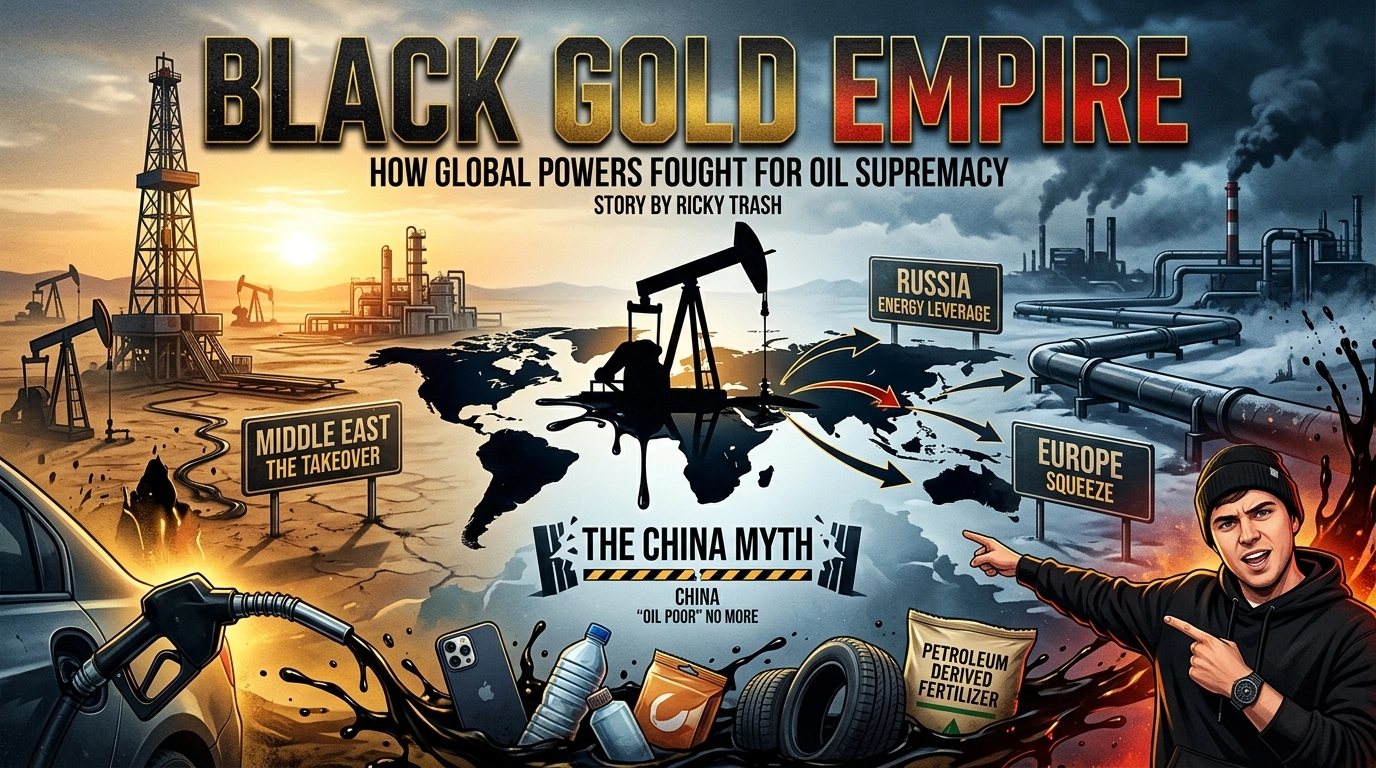
What is up, my digital explorers? It’s your boy, Ricky Trash, back again to peel back the curtain on the world’s most dangerous and lucrative game. We aren’t talking about crypto or dropshipping today. We are going back to the OG money-maker. I’m talking about the thick, viscous, “black gold” that runs the planet: Oil ( Black Gold Empire ).
If you think the tech wars of 2026 are wild, you haven’t seen anything yet. We’re diving into a story filled with secret deals, corporate takeovers, and geopolitical chess moves that would make a FiveM server admin’s head spin. Grab your coffee—or your energy drink—because we are about to break down how the Black Gold Empire was built and why it’s still holding the world by the throat.
The Spark: When the World First Struck Gold
Imagine it’s the mid-19th century. People are using whale oil to light their lamps. Can you imagine? Hunting massive sea creatures just to see at night. Then, in 1859, Edwin Drake strikes oil in Pennsylvania. Suddenly, the game changes. This wasn’t just a new fuel; it was a revolution.
In the beginning, it was a free-for-all. But as soon as the industrial world realized that oil could power engines, ships, and eventually planes, the “Black Gold Empire” stopped being a local business and became a global obsession. The race was on to find where else this liquid magic was hiding.
The Great Middle East Takeover
Now, let’s talk about the Middle East. For a long time, the West looked at this region and saw nothing but sand and history. They had no idea they were sitting on the world’s largest piggy bank.
When the first major discoveries happened in places like Persia (modern-day Iran) and later Saudi Arabia, the corporate giants didn’t just knock on the door; they kicked it down. We’re talking about the “Seven Sisters”—the massive oil companies that basically wrote the rules of the Black Gold Empire for decades.
They secured “concessions,” which is just a fancy word for “we pay you a little bit of money, and we take all your oil for the next 60 years.” It was a masterclass in corporate takeover. They built cities, pipelines, and empires in the middle of the desert, ensuring that the West’s industrial machine would never run out of juice, while the local populations often watched their most valuable resource flow straight to foreign ports.
The Great China Myth: “Nothing to See Here”
This is where the story gets spicy. For a long time, the narrative pushed by Western geologists and oil majors was that China was “oil-poor.” They literally told the world—and the Chinese—that there was no point looking there.
Was it a mistake? Or was it a strategic move to keep the Black Gold Empire concentrated in regions the West could control?
While the world was busy looking at the Middle East, China eventually proved everyone wrong. By the 1960s, they discovered the Daqing field, and suddenly, the “oil-poor” myth shattered. It goes to show you, guys: in the world of high-stakes resources, information is a weapon. If you can convince your competition they have nothing, they won’t even bother to look. Always verify your data, whether you’re trading forex or hunting for natural resources.
Russia’s Power Play: Squeezing the Old Continent
Fast forward to the modern era. If the Middle East is the heart of the Black Gold Empire, Russia is the iron fist.
Russia didn’t just discover oil; they mastered the art of using it as a diplomatic crowbar. For decades, Europe—the “Old Continent”—became addicted to cheap Russian energy. It made sense on paper: build a pipeline, get cheap gas, and keep the factories running.
But as we’ve seen in recent years, that addiction came with a price. When tension rises, Russia doesn’t need to send an army; they just need to turn a valve. By controlling the flow of oil and gas, they created a massive pressure point on Europe. It’s the ultimate leverage. When you control the energy that heats a person’s home and powers their car, you control their reality.
The Hidden Cost of the Black Gold Empire
Why do we care? Because oil isn’t just in your gas tank. Look around you right now. Your smartphone case? Plastic. Your sneakers? Synthetic polymers. The fertilizer used to grow the food in your fridge? All derived from the Black Gold Empire.
Our entire modern lifestyle is built on a foundation of petroleum. Every time you order a package online, it’s delivered by a logistics chain that breathes oil. We are so deep in this system that we don’t even see it anymore. It’s the ultimate “hidden in plain sight” business model.
The Future: Can the Empire Last?
We are living in a transition period. Everyone is talking about EV, hydrogen, and renewables. But let’s be real—the Black Gold Empire isn’t going to vanish overnight. There are trillions of dollars invested in the infrastructure of oil.
The shift is happening, but the giants are fighting back. They are rebranding, investing in tech, and trying to stay relevant in a world that is slowly trying to break its addiction. As an entrepreneur, you have to watch these shifts. The biggest opportunities always lie in the friction between the old world and the new.
Final Thoughts: The Hustle Never Sleeps
The story of oil is a story of power, deception, and incredible engineering. From the deserts of the Middle East to the pipelines of Siberia, the Black Gold Empire has shaped the map of the modern world. It’s a reminder that whoever controls the most essential resource sets the rules of the game.
What do you guys think? Is the age of oil finally coming to an end, or are we just seeing the empire move into a new phase? Drop your thoughts in the comments—I want to see some heated debates on this one.
Stay sharp, stay hungry, and keep building your own empire.
Peace,
Ricky Trash