
Welcome back to the den, legends! It’s Ricky Trash here. If you’ve been following our journey into the deep waters of the digital markets, you know we don’t just play the game—we analyze the code that runs it. Today, we’re stepping away from the firefighting frontline and diving straight into the burning heart of High-Frequency Trading.
We are talking about the “ghost in the machine,” the strategy that lets you profit from market inefficiencies before the average trader even blinks. Grab your coffee, settle in, and let’s break down the world of Arbitrage Algorithms.
What Exactly Is an Arbitrage Algorithm?
In the simplest terms, an arbitrage algorithm is a set of automated rules designed to exploit price discrepancies for the same asset across different markets or related instruments. Imagine seeing a pair of luxury sunglasses priced at $200 in a shop in Paris and finding out that the exact same pair is selling for $210 across the street in a different boutique. If you buy from the first and sell to the second, you’ve just performed manual arbitrage.
In the world of HFT, this happens in microseconds. Arbitrage Algorithms are the digital athletes that sprint across global exchanges to catch these gaps.
The Mechanics of Pure Speed
The reason we call these “risk-less profits” (though nothing is truly risk-free in finance) is that the algorithm isn’t betting on where the price will go in the future. It’s capitalizing on where the price is right now in two different places.
To succeed with an Arbitrage Algorithm, you need two things:
- Low Latency: Your server needs to be as close to the exchange as possible (Colocation).
- Smart Execution: The bot must be able to calculate transaction fees, slippage, and spread in real-time to ensure the “profit” isn’t swallowed by costs.
Spatial Arbitrage: The Global Sprint
The first major type is Spatial Arbitrage. This is the classic “buy low here, sell high there” model, but on a global scale.
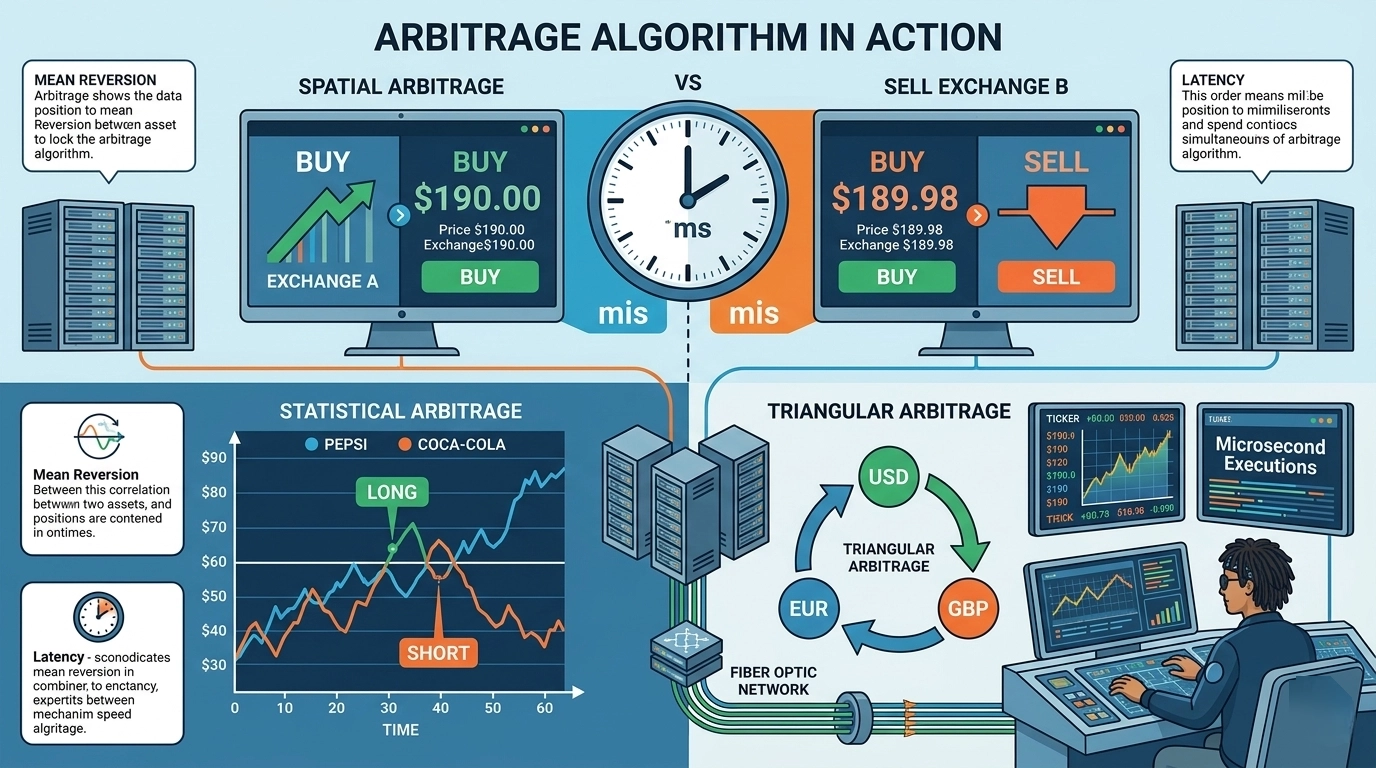
Imagine a stock like Apple (AAPL). It’s traded on the NASDAQ, but it’s also traded on European exchanges. Because of tiny delays in information flow or sudden bursts of buying pressure in one region, the price might be $190.00 in New York while it’s still lagging at $189.98 in London.
An Arbitrage Algorithm detects this $0.02 gap. It buys 100,000 shares in London and simultaneously sells them in New York. That’s a $2,000 profit in less than a second.
Ricky’s Insight: Why doesn’t everyone do this? Because by the time you see the gap on your retail trading screen, the HFT bots have already closed it. You aren’t competing with humans; you’re competing with fiber-optic cables.
Statistical Arbitrage: The Math Behind the Money
Now, let’s get a bit more “Smart Money.” While spatial arbitrage looks at the same asset, Statistical Arbitrage (or StatArb) looks at the relationship between different but related assets.
This is where the Arbitrage Algorithm becomes a mathematician. It looks at historical data between two correlated companies—say, Coca-Cola and Pepsi. Historically, these two move in a “dance.” If Coca-Cola goes up, Pepsi usually follows.
If the algorithm detects that Coca-Cola has surged while Pepsi is lagging behind for no fundamental reason, it assumes the “elastic band” will eventually snap back. It will go long on Pepsi and short on Coca-Cola, betting that the relationship will return to its mean. This is often called “Mean Reversion.”
Why Arbitrage Algorithms Rule the 2026 Markets
As we navigate through 2026, the markets have become more fragmented than ever. With the rise of decentralized finance (DeFi) alongside traditional legacy exchanges, the opportunities for an Arbitrage Algorithm have actually increased, not decreased.
- Crypto Arbitrage: Prices on Binance might differ from prices on a decentralized exchange like Uniswap.
- Triangular Arbitrage: This involves three currencies. You trade USD for EUR, EUR for GBP, and then GBP back to USD. If the exchange rates aren’t perfectly aligned, the loop ends with more USD than you started with.
Challenges: It’s Not All Easy Gains
I’ve always told you guys: “If it was easy, everyone would be doing it.” Running a successful Arbitrage Algorithm requires heavy lifting:
- The Arms Race: You are constantly upgrading hardware. If your competitor’s cable is one meter shorter than yours, they win.
- Toxic Flow: Sometimes you try to arbitrage against a “market maker” who is smarter than your bot, leading to “adverse selection” where you get filled on the wrong side of a massive move.
- Regulatory Hurdles: Different countries have different rules about how fast you can cancel orders, which can kill a strategy overnight.
Integrating Arbitrage into a Modern Strategy
If you are a solo developer or a retail trader looking at these concepts, you might think you can’t compete. But here’s the secret: you don’t have to compete with the giants in the New York Stock Exchange.
Many traders use the logic of an Arbitrage Algorithm to inform their manual trading. By watching the “Lead” and “Lag” indicators between markets, you can get a “heads up” on where the price is likely to move next on your local exchange. This is the essence of understanding price delivery and institutional liquidity.
Looking Ahead: The Future of Algorithmic Trading
As I manage our digital platforms and look into luxury trends and finance, one thing is clear: Automation is the king. Whether I’m optimizing a WordPress site with Rank Math or analyzing an order block on a 1-minute chart, the goal is efficiency.
The Arbitrage Algorithm is the peak of that efficiency. It is the ultimate expression of the “Smart Money Concept”—finding value where others see noise and executing with zero emotion.
Final Thoughts from Ricky Trash
We’ve covered a lot of ground today. From the split-second execution of spatial gaps to the complex mathematical modeling of statistical relationships, it’s clear that algorithms are the backbone of modern finance.
The question is: Are you going to be the one providing the liquidity, or the one getting “arbitraged” by the big players? Knowledge is the only way to stay on the right side of that equation.
What do you think? Are these algorithms making the market fairer by keeping prices consistent, or are they just “skimming the cream” off the top of every trade? Let’s talk about it in the comments below! I’m heading back to the station for my shift, but I’ll be checking in to see your thoughts.
Stay sharp, stay profitable, and keep building.
— Ricky Trash
Disclaimer: Trading involves significant risk. This article is for educational and entertainment purposes only. Ricky Trash is not responsible for your blown accounts—only the machine is.